
Customer 360 vs MDM vs CDP vs CRM


What each capability is for
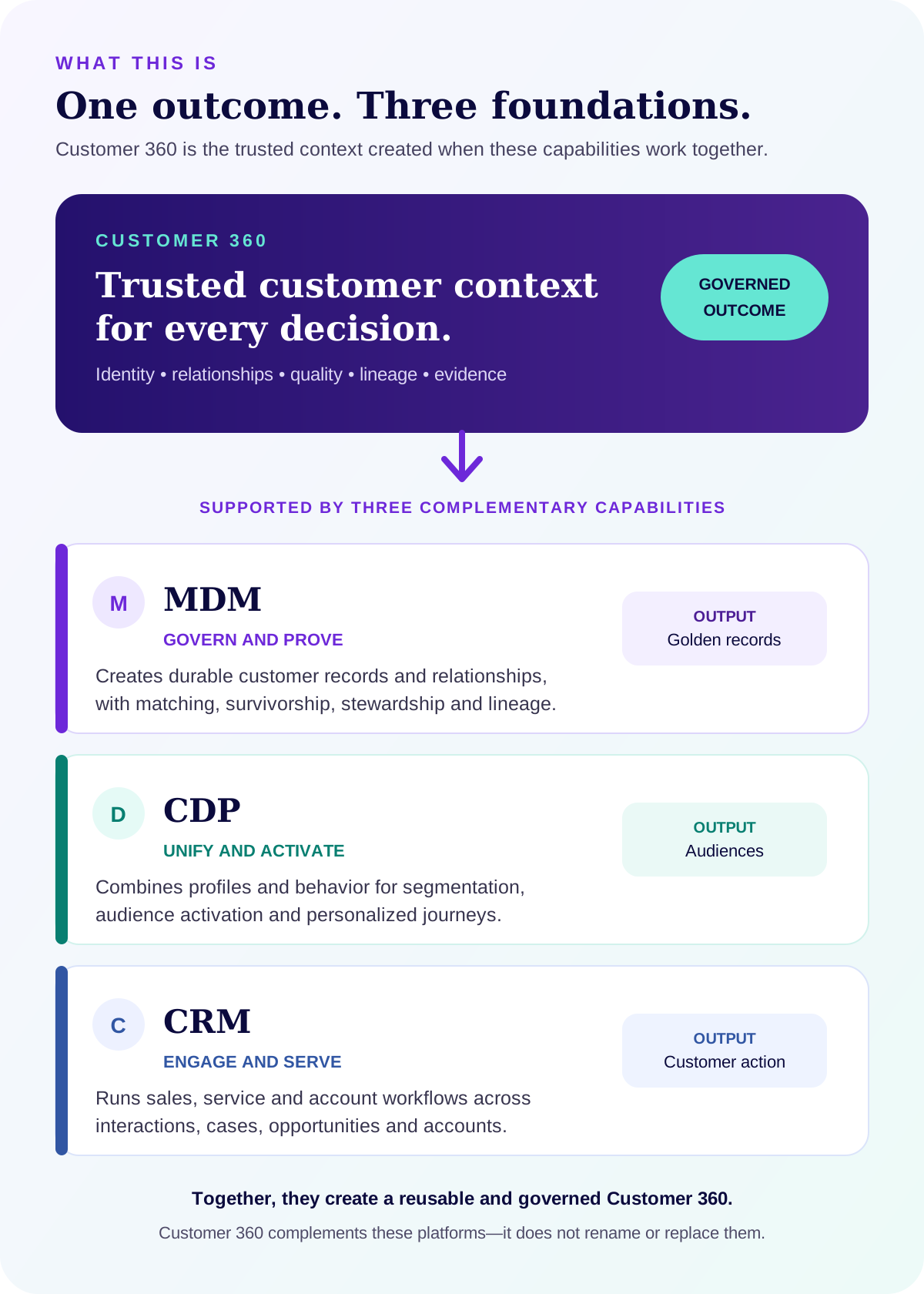
Customer 360 is not a fourth application category. It is the governed outcome created when trusted customer identity and relationships are shared across CRM, CDP, service, billing, analytics and AI. MDM provides the durable governance foundation; the other systems continue doing the jobs they were designed for.
- Customer 360 is the shared business outcome.
- MDM is the governed customer master.
- CDP activates profiles and audiences.
- CRM runs sales and service operations.
How the capabilities differ
| Dimension | Customer 360 | MDM | CDP | CRM |
|---|---|---|---|---|
| Primary role | Shared business outcome. | Governed customer master. | Profile and audience activation. | Sales and service operations. |
| Identity | Consistent identity across environments. | Matches durable person and organization records. | Stitches known and anonymous identifiers into activation profiles. | Identifies customers within operational workflows. |
| Governance | Shared trust and reuse. | Stewardship, survivorship, relationships, lineage and controlled change. | Consent, usage policies and profile merge rules. | Application permissions and process controls. |
| Primary data | Governed identity plus relevant context. | Durable entity attributes and relationships. | Behavior, events, traits and audiences. | Accounts, contacts, activities, cases and opportunities. |
| Output | Reusable trusted context. | Golden records and governed relationships. | Profiles, segments and activated audiences. | Sales and service actions. |
| Best starting point | When several systems need the same customer context. | When duplicates, ownership and traceability are the problem. | When digital segmentation and activation are the priority. | When customer-facing workflow is the need. |
How Customer 360, MDM, CDP and CRM work together
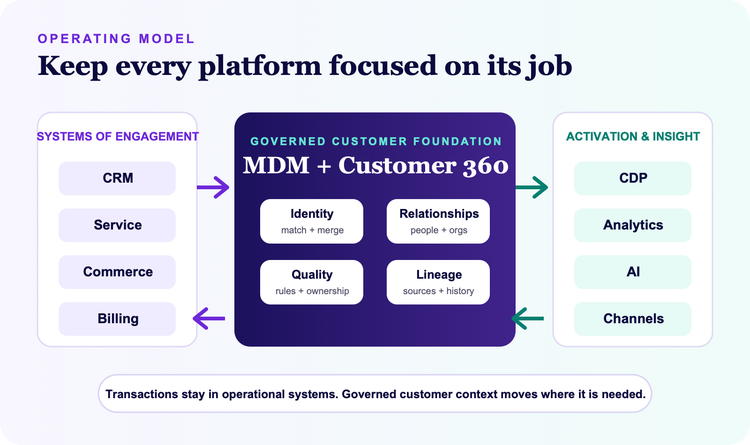
CRM and other source systems continue to run business processes. A CDP may collect digital behavior and create audiences. MDM reconciles the durable customer entities and relationships shared across systems. Customer 360 brings that governed context into service, onboarding, analytics and AI.
The goal is not to replace every application. It is to give those applications the same trusted customer identity, relationships, quality and lineage.
Where should you start?
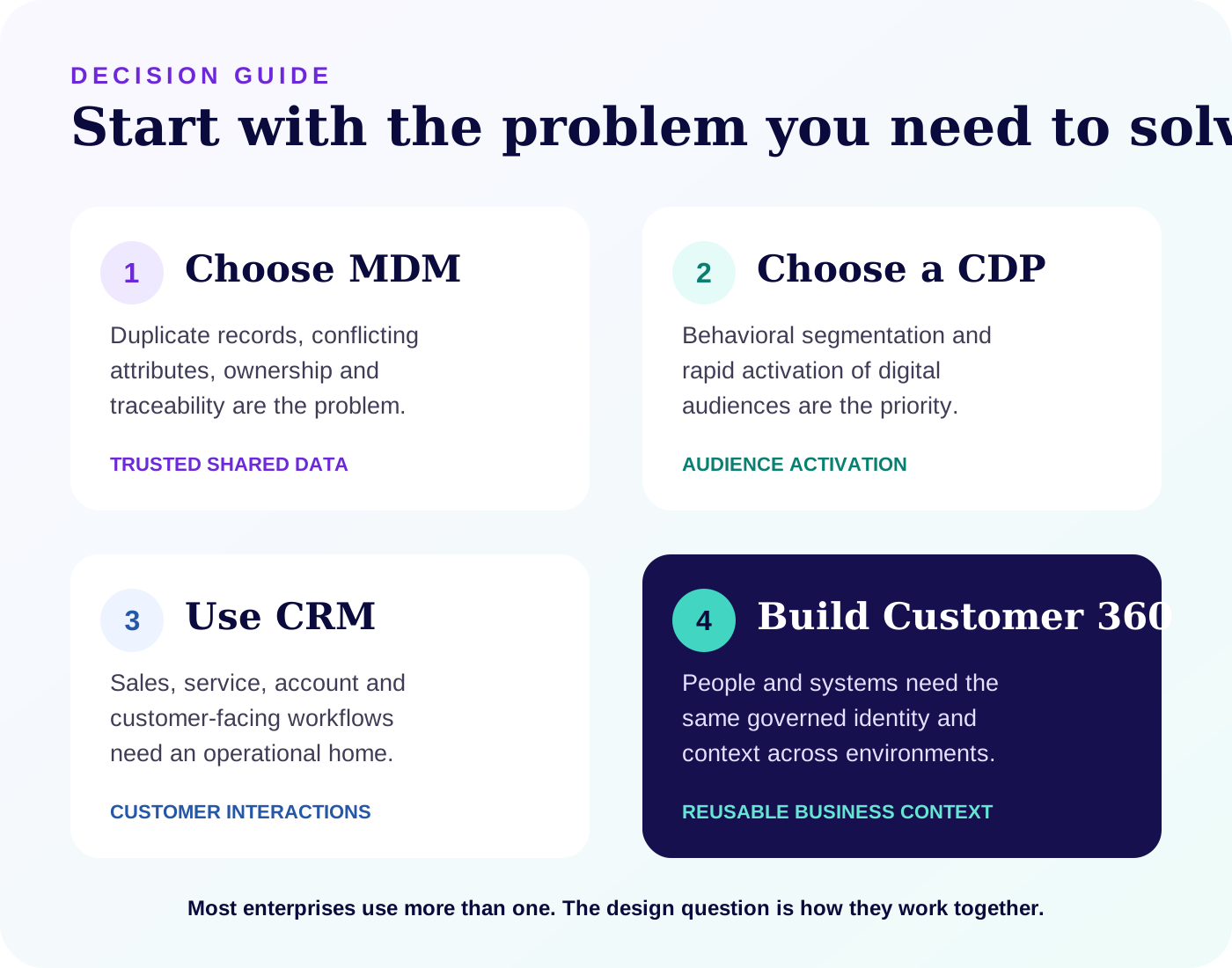
- Start with MDM when duplicate records, conflicting attributes, ownership and traceability are the core problems.
- Add a CDP when behavioral segmentation and rapid activation of digital audiences are the priority.
- Use CRM to manage customer-facing sales, service and account workflows.
- Establish Customer 360 across them when people and systems need the same governed customer context.
Most enterprises use more than one. The design question is how they work together.
What a governed Customer 360 architecture changes
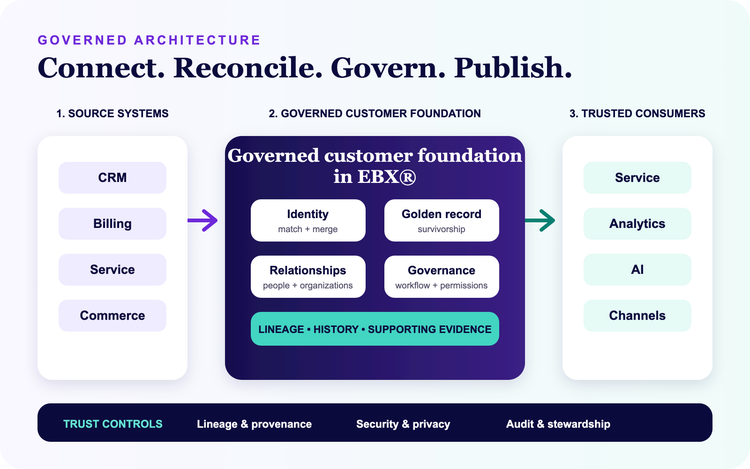
Source applications remain responsible for the transactions and processes they run. Customer data is connected, standardized and matched in a governed foundation, then published to CRM, service, billing, analytics and AI through configured integrations.
- Source identifiers and contributing records remain traceable.
- Stewards review uncertain matches and controlled changes.
- Golden records use explicit survivorship rules.
- Operational systems receive trusted context without losing their purpose.
Use the comparison to plan your next step
If your organization already has CRM and a CDP, Customer 360 can provide the governed identity and relationship layer they do not replace. If you already have MDM, Customer 360 turns that trusted foundation into reusable business context.
Explore the complete Customer 360 solution, or read what master data management means in practice.
Explore Customer 360


Build a governed Customer 360 with EBX®
Connect customer records, resolve identities and publish trusted context to the systems your teams already use.
