
Know every customer, once
Customer data is spread across CRM, billing, service, marketing and finance systems, and each one keeps its own version of the same person or company. The result is duplicate records, inconsistent details and no reliable answer to simple questions: who is this customer, what do they own, and how are they connected to the rest of the business?
EBX® brings customer, party and counterparty data together into governed golden records, with the relationships, hierarchies and history that give them context, and shares that trusted view with every system and team that needs it.
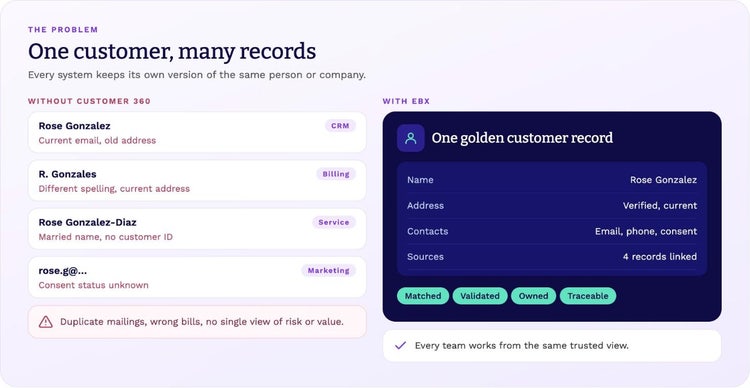
The problem: one customer, many records
The same customer appears in the CRM with a current email but an old address, in billing with a different spelling, in the service desk under a married name, and in marketing with an unknown consent status. Nobody is wrong, but nobody has the full picture.
The cost shows up everywhere: duplicate mailings and wrong invoices, sales teams that miss existing relationships, risk teams that can't see total exposure, and compliance processes that depend on manual reconciliation.
One trusted list of customers
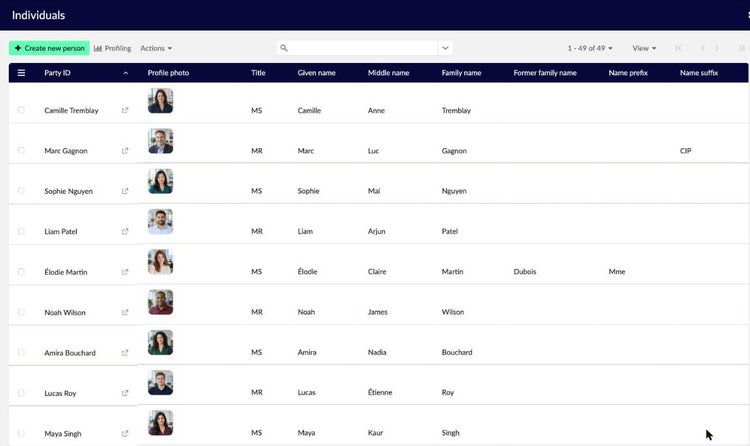
EBX holds the golden record for each person and organization, consolidated from every source system. Business users see one list of customers, searchable and governed, instead of a different list in every application.
The data model is yours: individuals, organizations, contacts, addresses, identifiers and any attributes your business needs, defined once and validated on every change.
A 360-degree profile for every customer
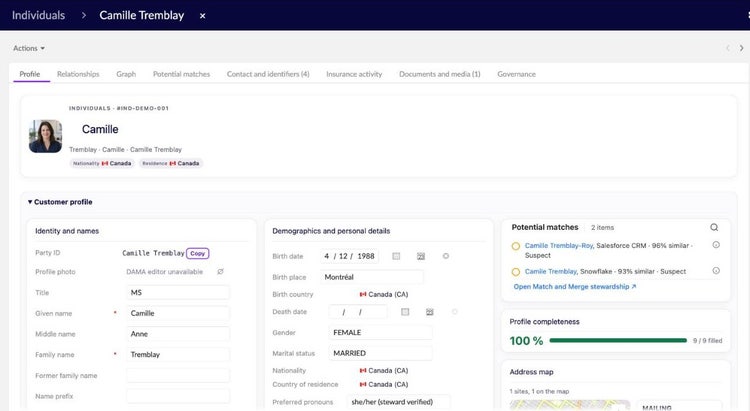
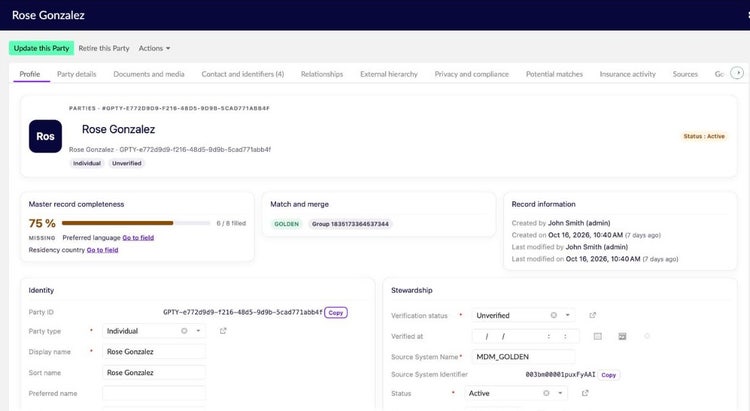
Each customer record brings together identity, demographics, contact details, addresses, documents and relationships in one profile. Completeness indicators show what is missing, and potential matches from other sources are flagged right on the record for review.
Because the profile is built from governed master data, every team sees the same facts, with the same definitions.
Match and merge: from many records to one
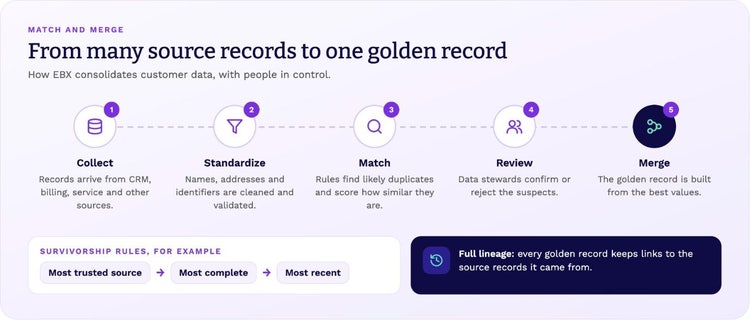
EBX match and merge consolidates customer records in a controlled way. Incoming records are standardized and validated, matching rules find likely duplicates and score their similarity, and data stewards confirm or reject the suspects.
Survivorship rules then build the golden record from the best values, for example the most trusted source first, then the most complete, then the most recent.
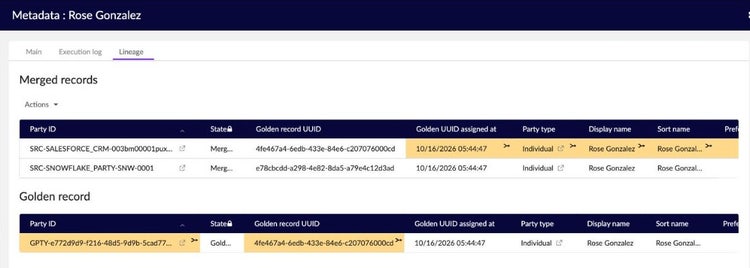
Every golden record is traceable
A golden record is only trusted if you can explain where it came from. EBX keeps the link between each golden record and the source records that were merged into it, along with when it happened.
When a source system sends an update, or someone asks why a value is what it is, the answer is one click away.
Data quality and stewardship built in
Each golden record shows its match and merge status, its completeness and the fields still missing, and its verification status. Validation rules check every change, and stewards can see at a glance which records need attention.
Quality becomes part of daily work rather than a clean-up project.
Relationships and hierarchies
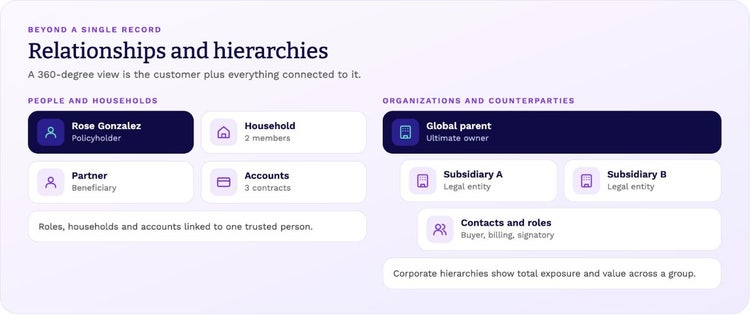
A 360-degree view is more than one record. EBX links people to households, roles and accounts, and organizations to their parents, subsidiaries, contacts and counterparties.
Corporate hierarchies show total exposure and value across a group, and relationship data helps sales, service and risk teams see the whole customer, not just one account.
Search before create, and govern every change
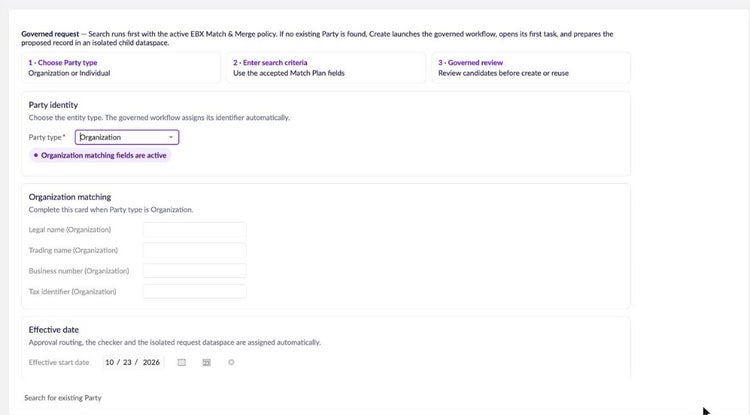
The best way to avoid duplicates is not to create them. In EBX, a new customer request starts with a search against existing records using the match rules. Only if no match is found does the request continue.
The proposed record is prepared in an isolated dataspace, reviewed and approved through a workflow, and only then becomes part of the golden data. Permissions protect sensitive attributes, and the history of every change is kept.
Customer story: PostNL
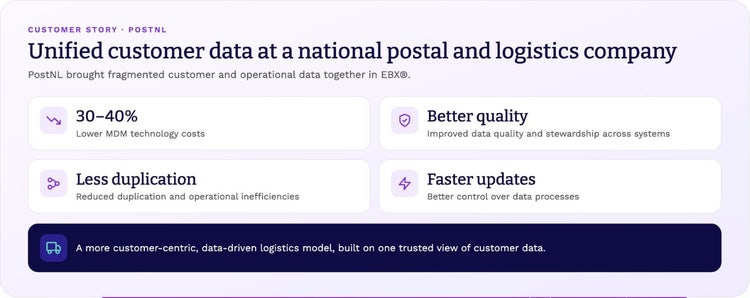
PostNL, the national postal and logistics company of the Netherlands, used EBX to unify fragmented customer and operational data and move toward a more customer-centric, data-driven logistics model.
The results: improved data quality and stewardship across systems, less duplication, faster updates with better control over data processes, and a 30–40% reduction in MDM technology costs.
Customer 360: common questions
What is Customer 360?
Customer 360 is a single, trusted view of each customer, built by consolidating records from every system, removing duplicates and linking the customer to its contacts, accounts, relationships and hierarchies. Learn more: What is master data?
What is the difference between customer, party and counterparty data?
A party is any person or organization the business deals with. Customers are parties that buy from you; counterparties are parties on the other side of a financial contract or transaction. EBX can manage them in one party model, so the same company is not maintained three times.
How does EBX find duplicate customers?
EBX match and merge applies matching rules to names, identifiers, addresses and other attributes, scores how similar records are, and either merges them automatically or sends suspects to data stewards. Survivorship rules decide which values make it into the golden record.
Do we have to replace our CRM or other source systems?
No. Source systems keep running. EBX consolidates their records, keeps the link from each golden record back to its sources, and shares the trusted version with the systems and teams that need it. Learn more: What is master data management?
How is sensitive customer data protected?
Permissions control who can see and change each record and attribute, changes go through governed workflows, and EBX keeps the history of who changed what and when, which supports privacy and compliance processes.
See your customers clearly
Talk to our team about consolidating customer, party and counterparty data, or explore how EBX® models, governs and shares master data, reference data and metadata in one platform.
