
Customer 360 data model


Start with people and organizations
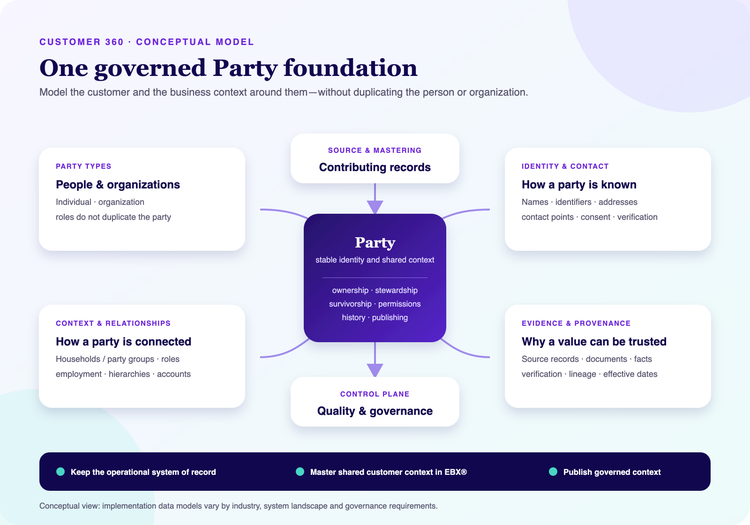
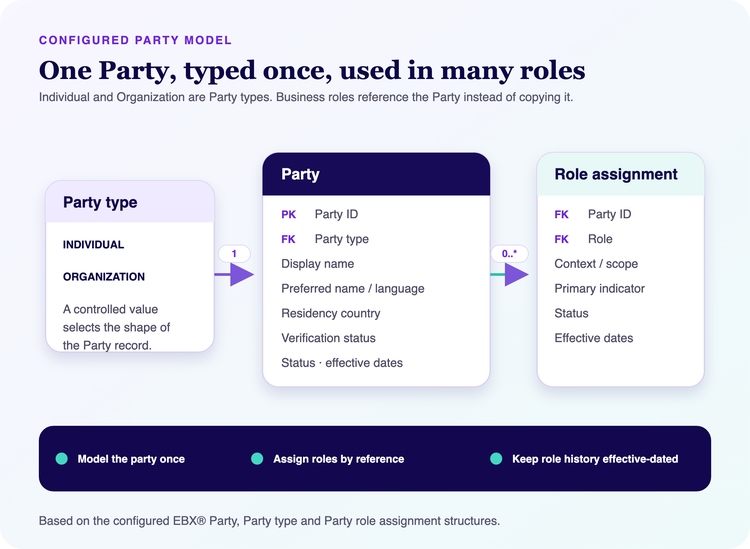
Model an individual or an organization once as a Party, then connect the identities, contact points, addresses and source records that describe it. In the EBX® Party model, households are represented as party groups with governed memberships—not as another Party type.
Roles such as customer, policyholder, beneficiary, buyer, billing contact and signatory describe how a person or organization participates in a business process. They add context without creating another copy of the party.
Separate the mastered party from contributing records
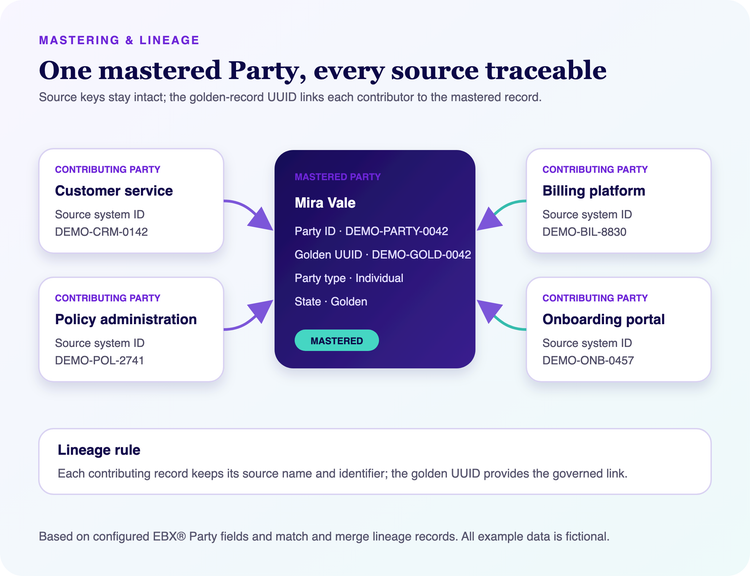
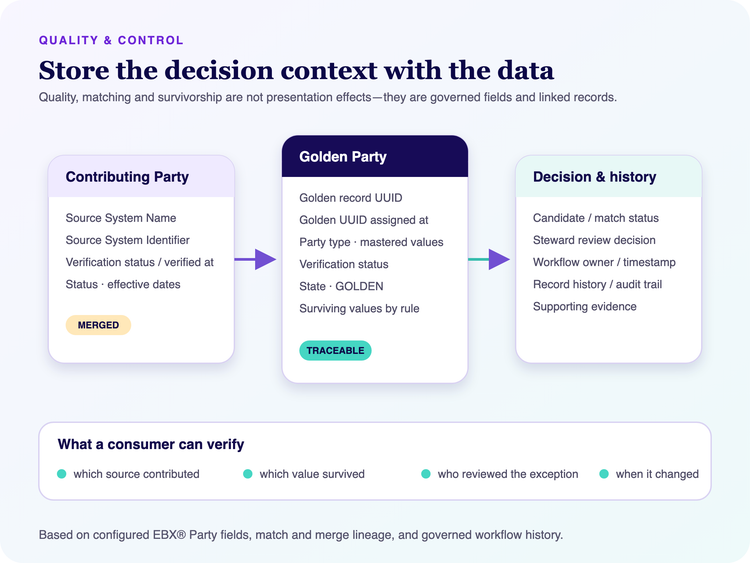
A governed Customer 360 keeps the mastered Party and its source records related but distinct. The trusted profile can evolve without erasing the identifiers, values and evidence supplied by CRM, billing, service, policy-administration or onboarding systems.
- Identity: names, identifiers, dates and organization registration details.
- Contact and addresses: email, phone, consent and structured postal data with usage and verification status.
- Contributing records: the original source keys and source-system context used during matching and consolidation.
- Evidence and provenance: supporting documents, ownership, timestamps and lineage for values and decisions.
This separation lets users explain where a value came from, which record contributed it and which system remains responsible for the source.
Model relationships and groups explicitly
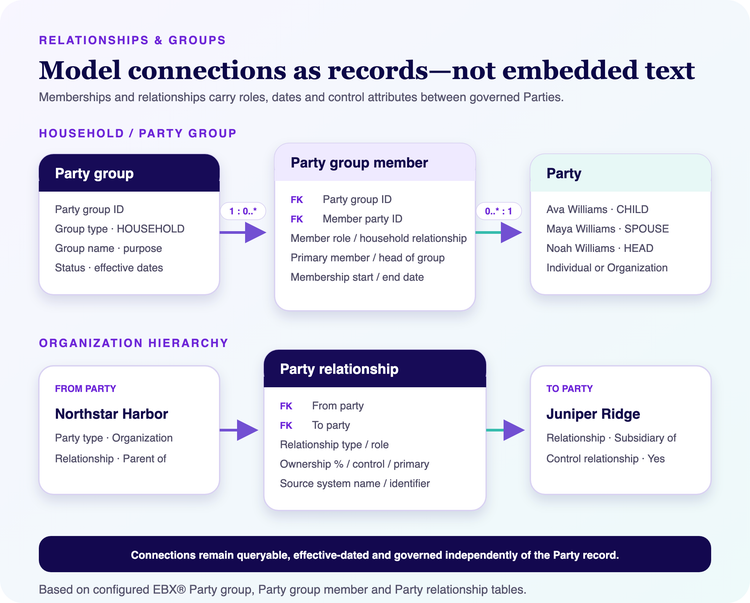
Customer context is not stored by copying household or corporate data into every Party record. The model represents a household as a Party group and links people to it through governed memberships. Organizations remain Parties and can be connected through typed parent, subsidiary, ownership or counterparty relationships.
Relationship and membership records carry their own role, status, effective dates, ownership and supporting evidence. This supports household service, corporate hierarchies, ultimate-owner analysis, account access and exposure calculations without flattening the network.
Read more about hierarchy management and customer hierarchy and householding.
Treat quality and control as part of the model
The data model makes ownership, verification status, completeness, effective dates, permissions, workflow state and change history queryable—not hidden in process documentation.
With steward review configured, potential matches and contributing records remain visible until an accountable steward accepts or rejects a merge. Golden-record values retain lineage to the source records and survivorship decisions that produced them.
This lets onboarding, service, analytics, risk and AI consumers understand not only the value they receive, but also its quality, provenance and approval state.
Publish governed context without replacing operational systems
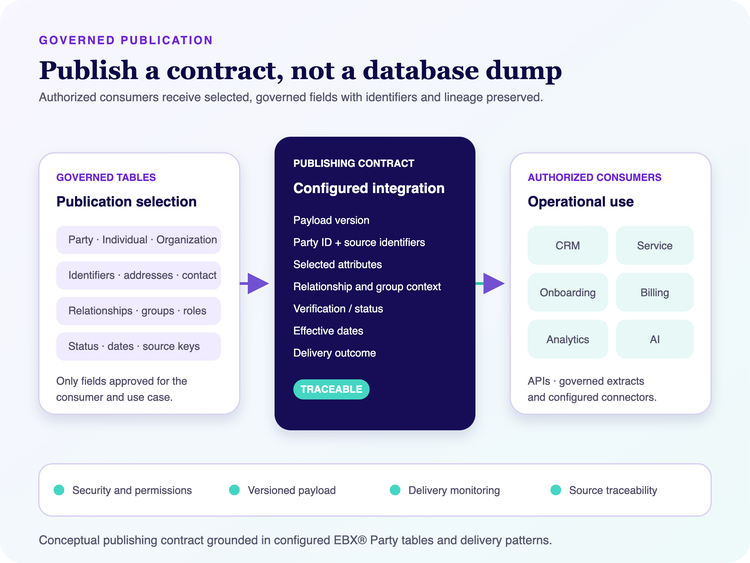
CRM, billing, service, commerce, policy and analytics systems keep running the transactions they were designed to run. EBX publishes common identifiers, trusted attributes, relationships and quality context through configured APIs, files and integrations.
Design principle: master shared customer context in EBX; leave transactions with the operational systems that run them.
Keep exploring Customer 360
See how the data model connects to the rest of a governed Customer 360, from source systems to matching, golden records and households.


Model governed customer context with EBX®
Connect identity, relationships, evidence and source lineage in a reusable customer foundation.
