align-left
green-eyebrow
ON EBX › CUSTOMER 360 › IDENTITY RESOLUTION

Resolve customer identities with accountable match decisions


Identity resolution determines which records describe the same person or organization. A governed process standardizes data, finds candidates, explains similarity, routes uncertainty to stewards and preserves the evidence behind every merge.
cta-available
Explore Customer 360
/content/eds-onebx-com/use-cases/customer-360.html
Abstract geometric Customer 360 banner in ON EBX purple, blue and teal

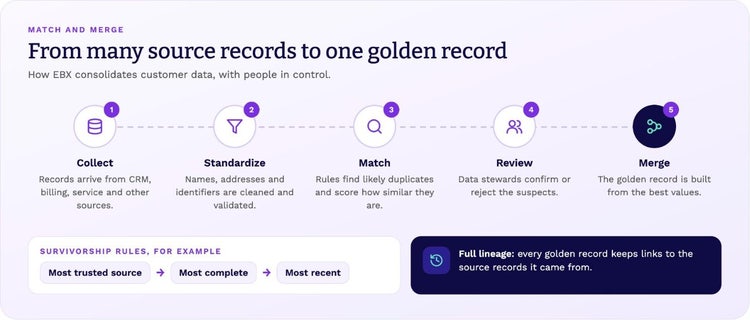
Five steps of identity resolution in EBX: collect, standardize, match, review and merge, with survivorship rules and full lineage

SOURCE RECORDS

Preserve source identity from the start

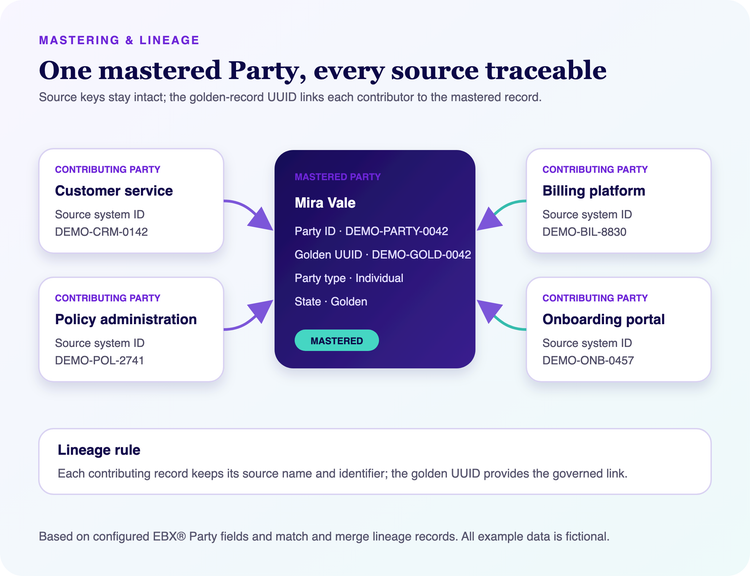
Customer records arrive from CRM, billing, service, policy, onboarding and other systems. Each contributing record keeps its original source identifier so it can be traced, corrected and republished without losing provenance.
ct-pb-49,align-left,t-body,ct-title-mw-750
One mastered Party linked to four contributing source records, each keeping its own source system identifier
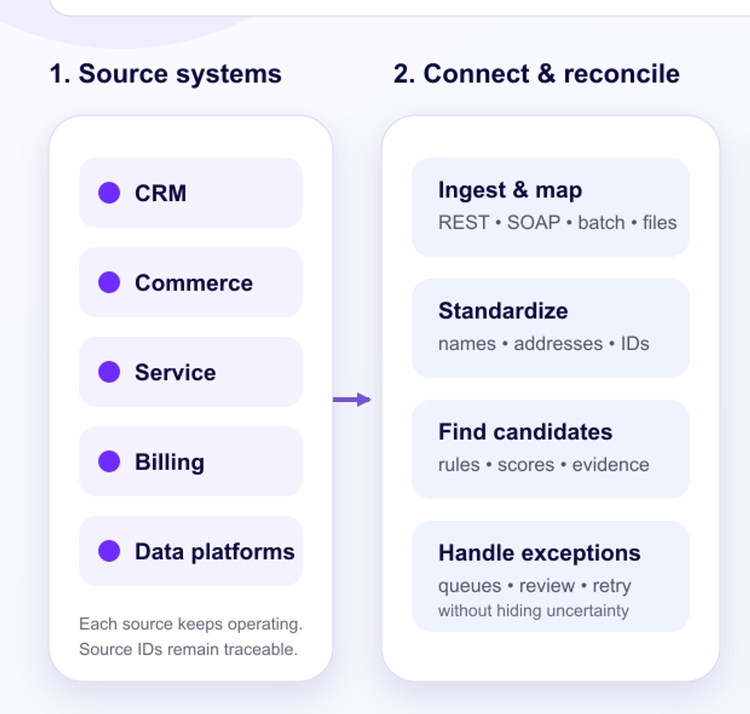
Source systems feeding ingest, standardization, candidate search and exception handling
STANDARDIZATION

Compare consistent values

Names, addresses, phone numbers, emails and official identifiers are parsed and normalized before matching. Validation and reference data improve comparability while the original source values remain available for lineage.

Standardization reduces false differences; it does not hide missing or uncertain information.

ct-pb-49,align-left,t-body,ct-title-mw-750
CANDIDATES

Use rules appropriate to the business

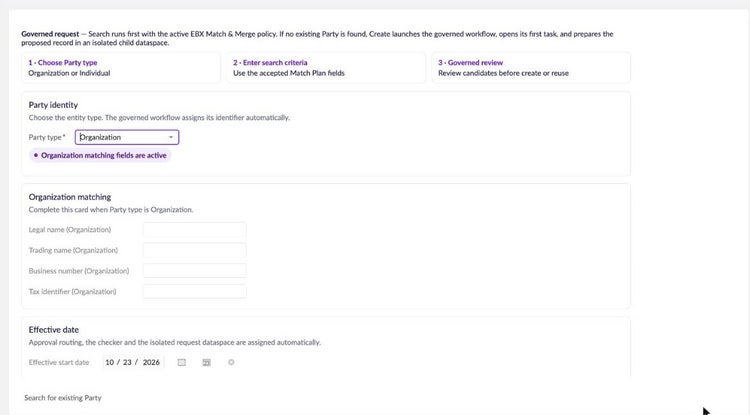
Candidate rules narrow the search to plausible duplicates. Matching considers exact and fuzzy similarities across multiple attributes. Scores, contributing evidence and rule outcomes remain visible so users can understand why records were proposed.

The right thresholds depend on risk: a marketing use case and a regulated onboarding decision may require different controls.
ct-pb-49,align-left,t-body,ct-title-mw-750
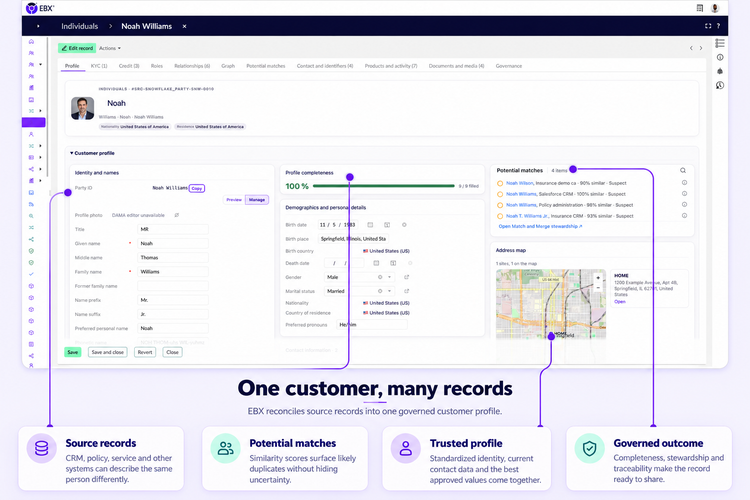
EBX customer profile with potential matches flagged for review alongside source records and the trusted profile
EBX governed request that searches for existing parties with the match policy and routes candidates to review before create or reuse
STEWARD REVIEW

Put people in control of uncertainty

High-confidence cases may follow configured automation. Ambiguous candidates enter a stewardship queue where an authorized person compares values, sources and evidence, then confirms or rejects the match.

The review decision, reviewer and timestamp become part of the governed history.

ct-pb-49,align-left,t-body,ct-title-mw-750
SURVIVORSHIP

Build a traceable golden record

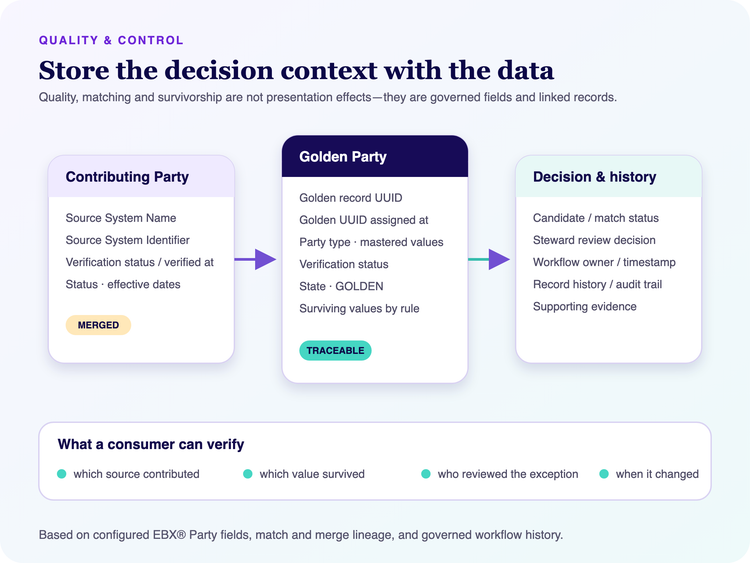
Survivorship rules choose the best values using trusted source, completeness, recency or other configured priorities. The merged record retains links to every contributing source and the history of how it was formed.

See how the result is modeled in the Golden customer record guide.
ct-pb-49,align-left,t-body,ct-title-mw-750
Contributing and golden Party records with stored match status, steward decision, surviving values by rule and audit history
CUSTOMER 360 GUIDES

Keep exploring Customer 360

See where matching fits in the wider architecture, how the data model supports it and what survives into the golden record.

ct-pb-49,align-left,t-body,ct-title-mw-750

Overview

Outcomes and how EBX builds it.

Read the guide

Comparison

How MDM, CDP and CRM work together.

Read the guide

Architecture

How sources, EBX and consumers connect.

Read the guide

Data model

Parties, roles and relationships.

Read the guide

Golden record

Survivorship, lineage and quality.

Read the guide

Householding

Households, corporate structures and roles.

Read the guide

FAQ
Common questions
h2
Is identity resolution the same as deduplication?
Deduplication removes repeated records. Identity resolution is broader: it determines whether records refer to the same real-world party, manages uncertainty and preserves evidence, lineage and decisions.
Can matching be fully automated?
Configured automation can handle appropriate high-confidence cases under defined governance rules. Ambiguous or high-risk decisions should remain reviewable and accountable.
What happens when a merge is wrong?
Because contributing records and merge history are retained, authorized stewards can investigate the decision and apply a governed correction.

Resolve identities with EBX®

Turn duplicate and conflicting customer records into explainable, governed match decisions.

Talk to ON EBX experts
/content/eds-onebx-com/contact-us.html
_self
Download the Customer 360 solution brief
https://docs.google.com/forms/d/e/1FAIpQLSd5LAflx0ZgRvlk8bVbYbOAX0mSWrQ9rFxi2WahcoutP_TyxA/viewform
Download the Customer 360 solution brief (opens a short form in a new tab)
_blank
_blank