
What is master data management?


What MDM does
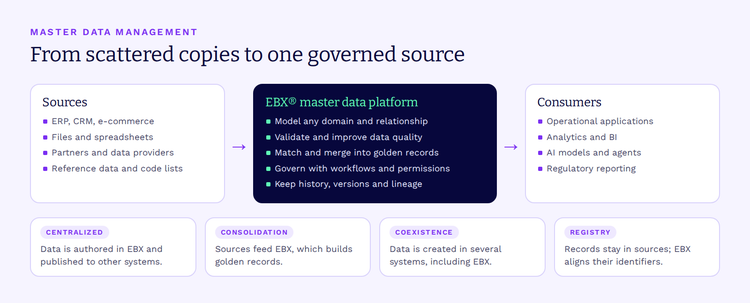
Every organization depends on a small set of shared data: who its customers and suppliers are, what it sells, where it operates. When that data is copied and changed in dozens of applications, it drifts. Master data management gives this shared data one governed home, so every application, report and AI model works from the same trusted facts.
An MDM program combines three things: people (data owners and stewards who decide what is correct), processes (how data is created, approved and changed) and an MDM platform such as EBX® that models, validates, matches and distributes the data.
The benefits of master data management
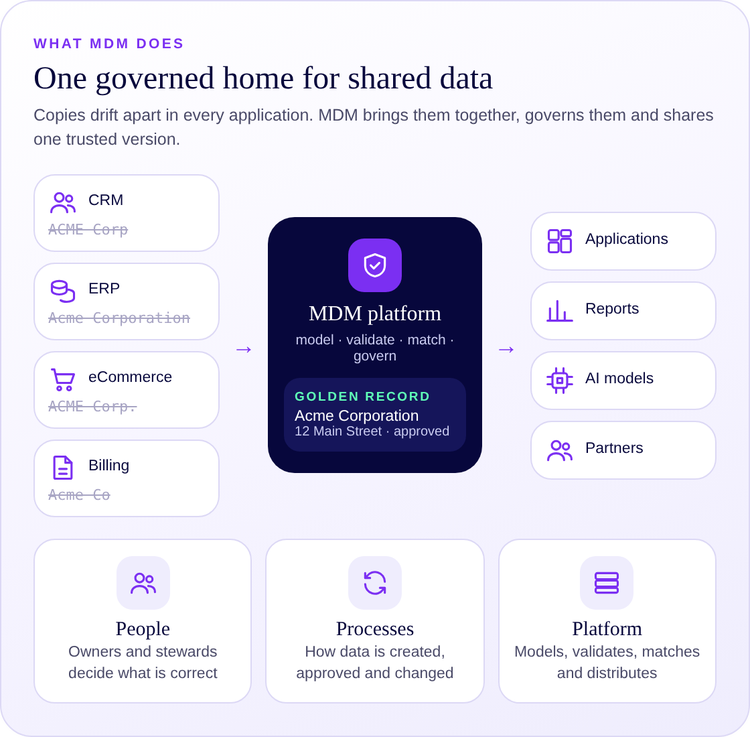
Grow revenue
Personalized cross-sell and up-sell offers need complete, reliable data for every customer touchpoint. MDM consolidates customer, product and relationship data so the right offer reaches the right customer, on the right channel, at the right time.
Improve productivity
One complete and consistent source of master data removes duplicate maintenance, reduces IT overhead and improves visibility over relationships between products, customers, vendors and locations.
Optimize the supply chain
A central view of products, inventory, returns and stock-outs improves forecasting, inventory management and customer service, and gives applications and people timely, accurate information.
Act on insights faster
Business users can access, manage and visually explore master data directly. Richer product, customer and vendor data shortens time to insight and helps teams launch new products and services faster.
Improve customer satisfaction
Consistent data across channels makes it possible to personalize interactions and tailor products and services to each customer, which builds loyalty and sales.
Strengthen compliance
Centralized, complete master data lowers the cost of compliance reporting and the risk of penalties, and fewer vendor and product issues mean faster onboarding and product introductions.
Essential MDM capabilities
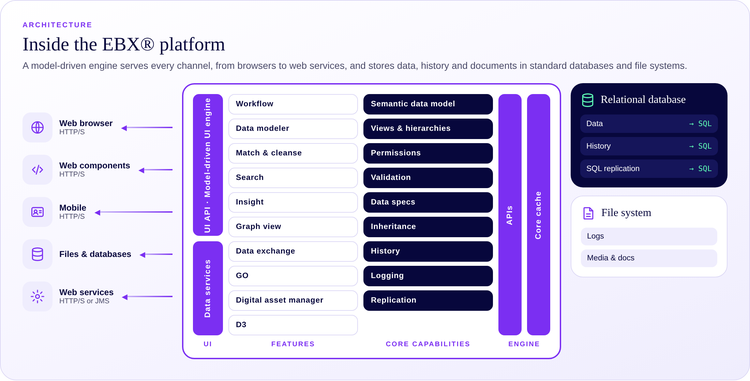
Flexible, multi-domain modeling
An extensible repository with flexible data modeling shows the relationships between all data types and clarifies complex cross-domain relationships, such as customers, products, suppliers, locations and reference data, in one platform.
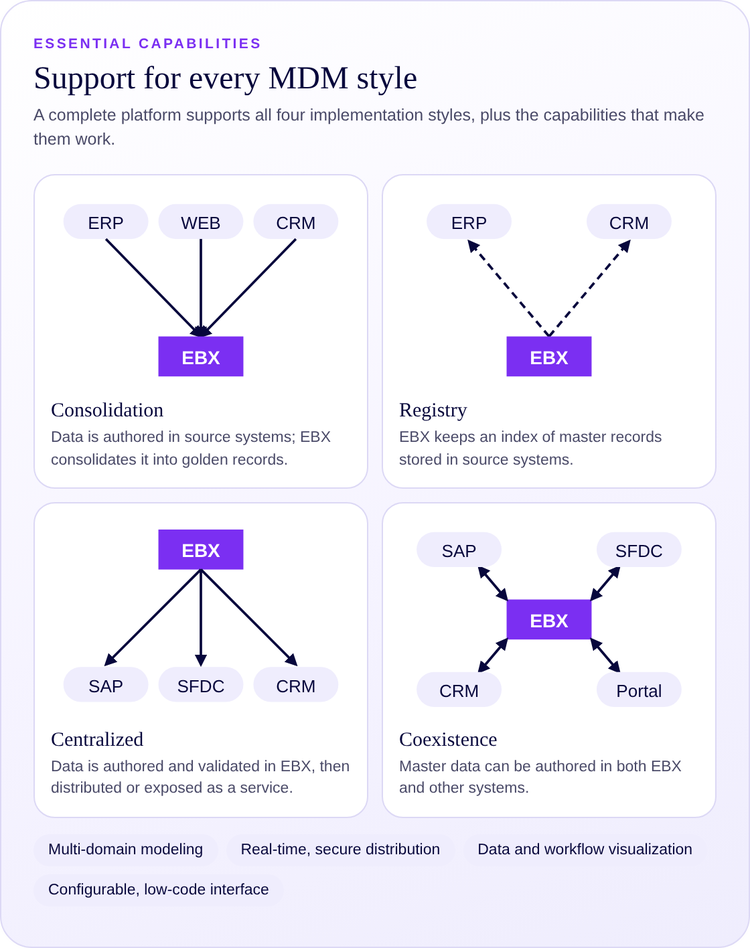
Support for every MDM style
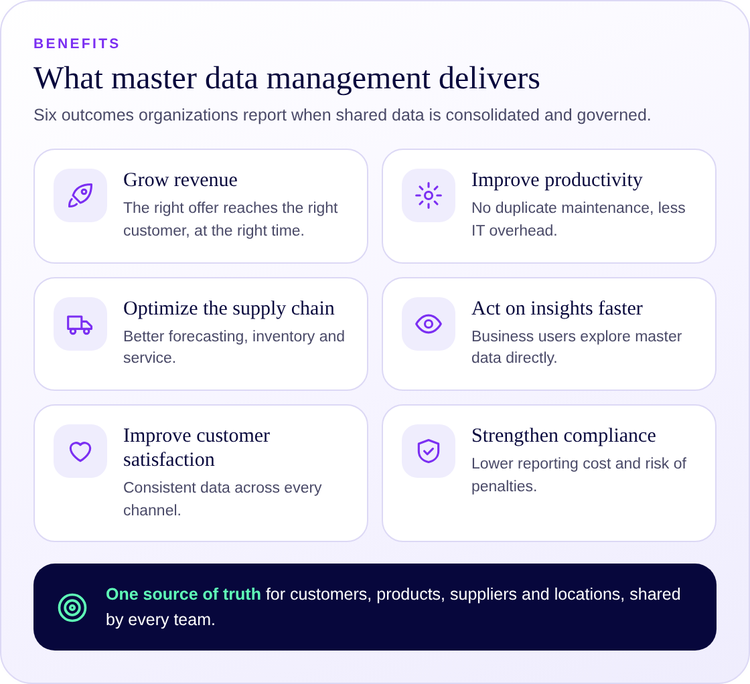
A complete MDM platform supports the four main implementation styles:
- Centralized (authoring): data is created in the MDM hub, and other systems subscribe to it or receive it.
- Consolidation: source systems feed the hub, which consolidates records into golden records.
- Coexistence: a blend of the two, where data can be created in several systems, including the hub.
- Registry: records stay in their sources, and the hub aligns their identifiers through cross-references.
Real-time, secure distribution
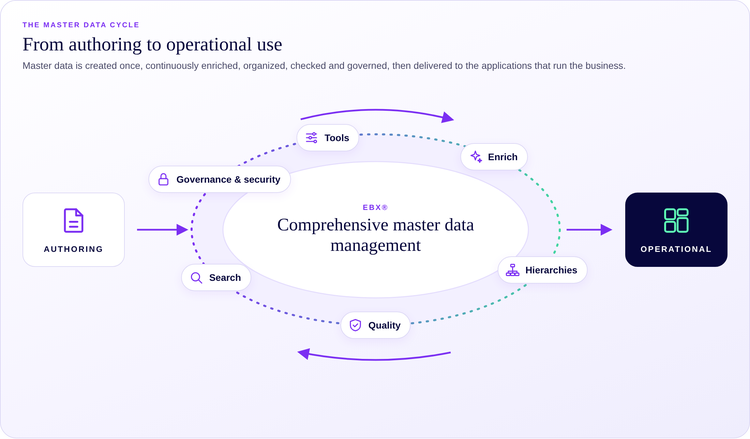
Leading MDM platforms publish data on demand and let systems subscribe to changes, so accurate master data reaches applications when and how they need it, without compromising security.
Data and workflow visualization
Visual tools help teams spot and fix quality issues, collaborate on improvements, monitor processes and build dashboards for actionable analysis.
A business-friendly, configurable interface
A model-driven, low-code design environment lets teams create clean, role-based user interfaces without custom development.
Getting the most value from MDM
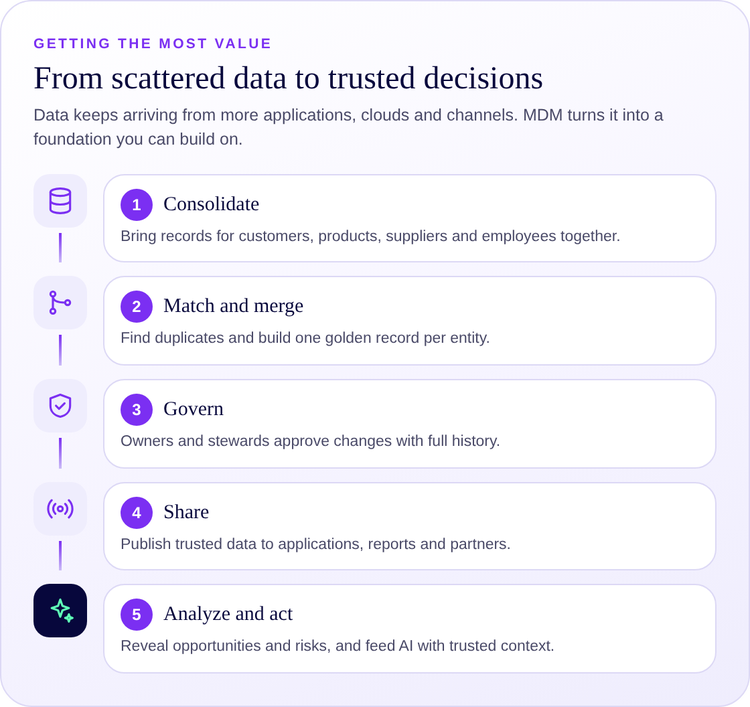
Data is one of an organization’s most important assets. Consolidated and matched accurately, it reveals opportunities, risks and areas to improve. The challenge is building and maintaining a trusted source for products, customers, suppliers, vendors and employees while data keeps arriving from more applications, clouds and channels. MDM gives organizations control over these key entities wherever they are scattered, and a trusted foundation for analytics and AI.
Getting this right pays off. According to an Aberdeen survey, organizations that successfully generate business value from their data outperform similar companies by 9% in organic revenue growth.
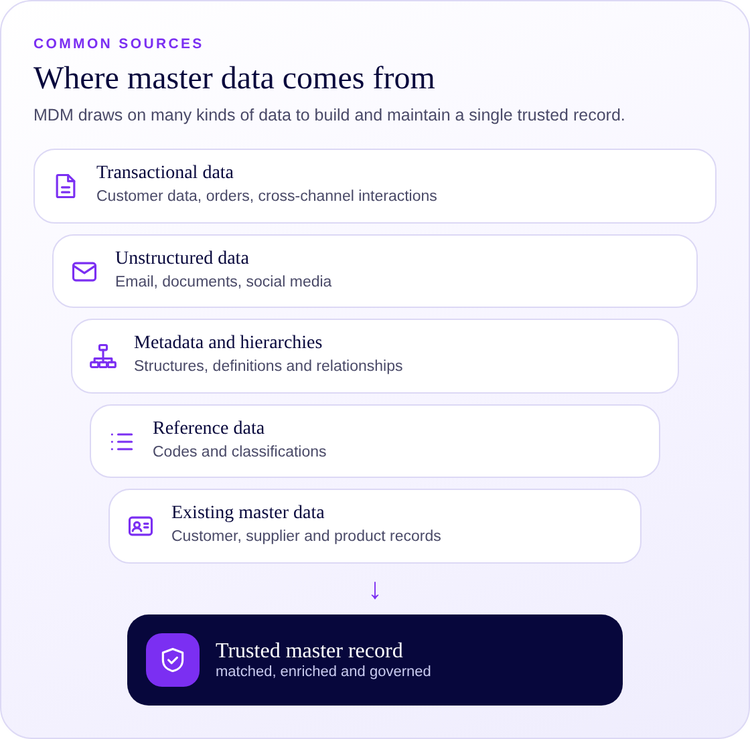
Common sources of master data
- Transactional data: customer data, orders, cross-channel interactions
- Unstructured data: email, documents, social media
- Metadata and hierarchical data
- Reference data
- Master data itself: customer, supplier and product data
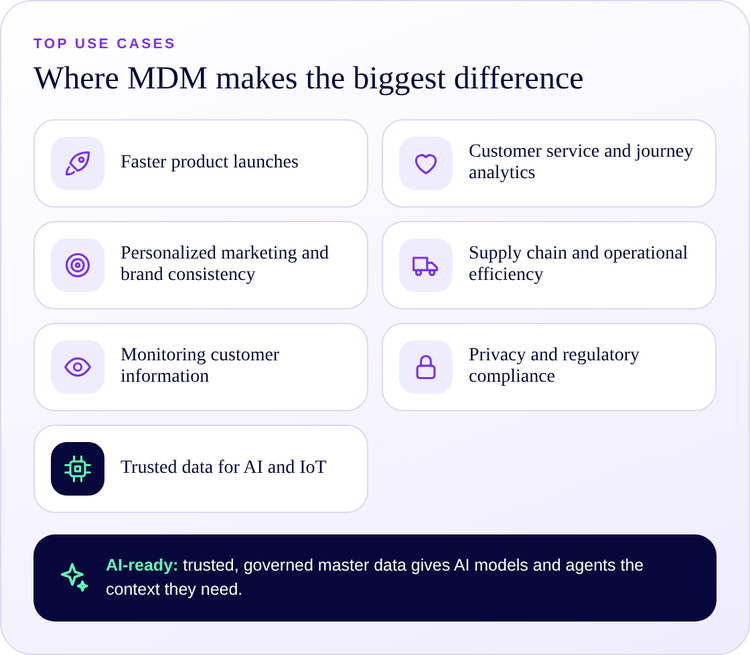
Top MDM use cases
- Faster product launches
- Better customer service and customer journey analytics
- Personalized marketing and brand consistency
- Supply chain and operational efficiency
- Monitoring customer information
- Trusted data for AI and IoT applications
- Privacy and regulatory compliance, such as GDPR
Manage master data with EBX®
Talk to our team about your master data goals, or explore how EBX® models, governs and shares master, reference and metadata in one platform.
