
What is a data catalog?


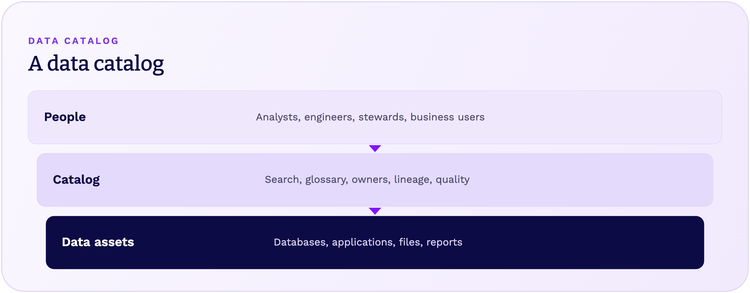
Why organizations need a data catalog
Data now lives in many databases, applications, clouds and file stores, in many formats, and is used by people with very different skills. Without a catalog, finding the right dataset depends on knowing who to ask, and every team re-discovers the same data on its own.
A catalog gives everyone one place to:
- find data by business term, not by table name;
- see what a dataset means, who owns it and how it is used;
- trace where it came from and what depends on it;
- judge its quality before using it;
- request access through a controlled process.
What a good data catalog includes
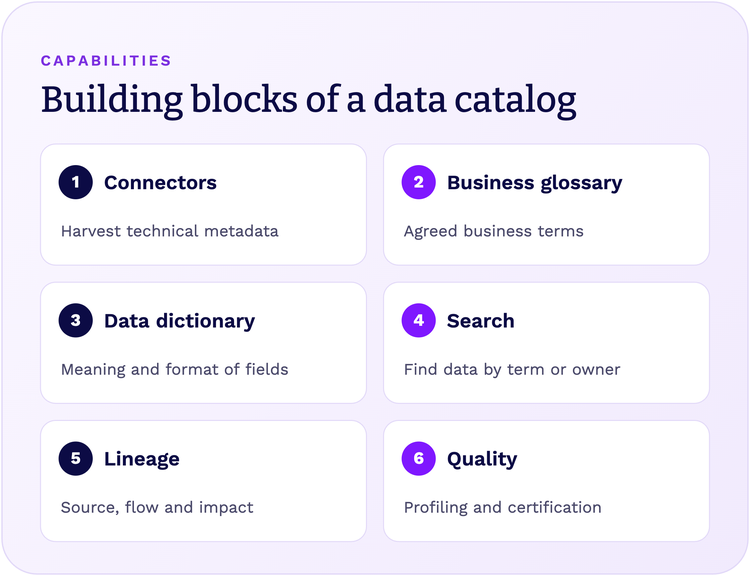
- Connectors and harvesting. Collect technical metadata from databases, applications and BI tools automatically, so the inventory stays current.
- Business glossary. Agreed definitions of business terms, linked to the fields that implement them.
- Data dictionary. The meaning, format and relationships of each data element.
- Search. Discovery by term, owner, domain or system, combining several criteria at once.
- Lineage. Where data came from, how it was transformed, and what depends on it.
- Profiling and quality. Completeness, validity and consistency, measured rather than assumed.
- Curation and certification. Stewards confirm which datasets are trusted for which uses.
Glossary, dictionary and lineage working together
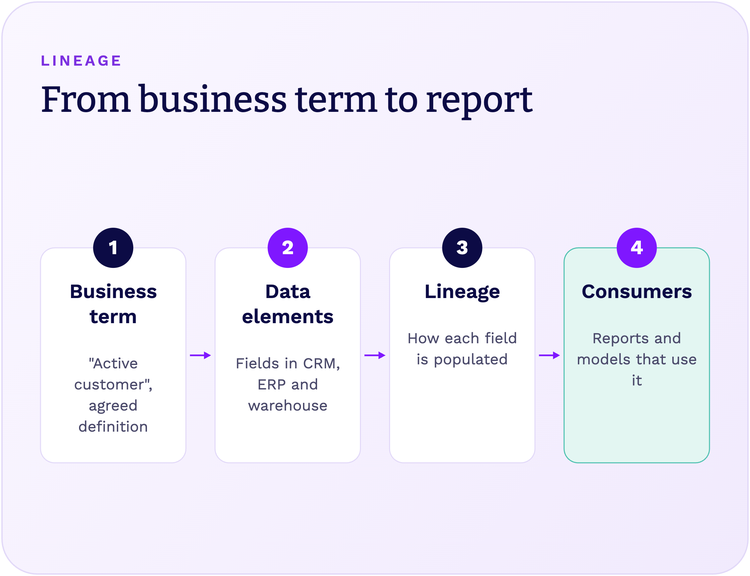
The three core pieces of a catalog answer different questions. The business glossary says what a term such as "active customer" means. The data dictionary says which fields in which systems hold it. Lineage says how those fields are populated and which reports and models use them. Linked together, they let someone start from a business question and arrive at trustworthy data, or start from a changed field and see everything it affects.
How EBX® supports cataloging and metadata
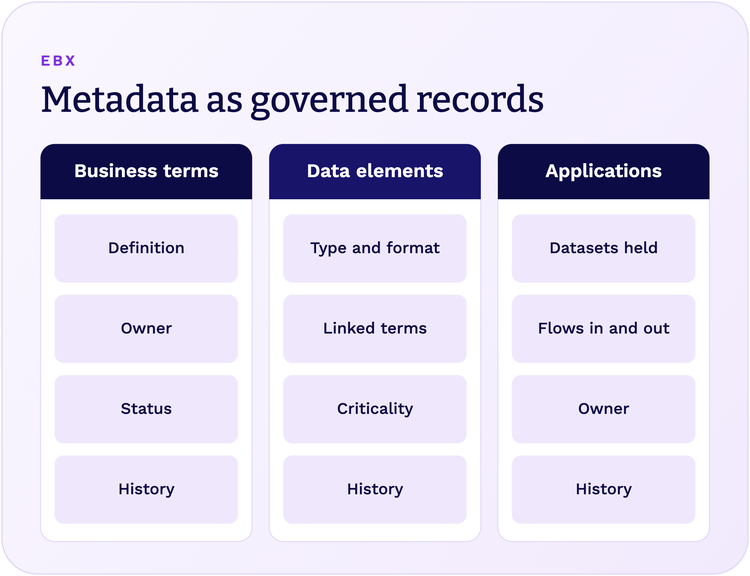
EBX® includes metadata management in the same platform as master and reference data. Business terms, data elements, datasets, applications and their relationships are governed records, with owners, workflows, validation and history, exactly like master data. That means the definitions in the catalog are subject to the same approval and audit as the data they describe.
Harvesting technical metadata from external sources uses the separate EBX Metadata Agent. See the metadata governance use case for details.
Frequently asked questions
What is the difference between a data catalog and metadata management?
Metadata management is the discipline of defining, governing and maintaining metadata. A data catalog is the searchable inventory that discipline produces for data consumers.
What is the difference between a data catalog and a business glossary?
A business glossary defines business terms. A data catalog links those terms to the actual datasets and fields that hold them, along with owners, lineage and quality.
Does a data catalog store the data itself?
No. A catalog stores metadata about data, and points to where the data lives.
Govern metadata like the data it describes
Manage business terms, data elements and lineage alongside master and reference data, with the same owners, workflows and history.
