
What is data governance?


Why organizations need data governance
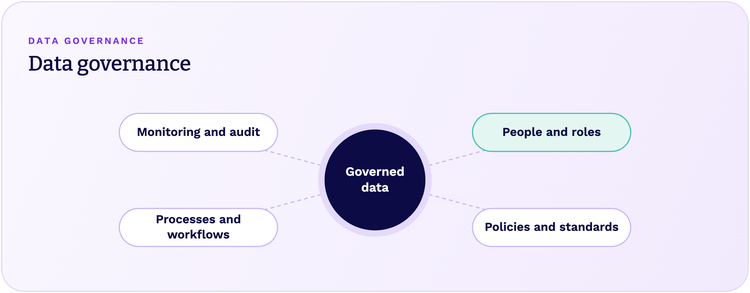
Without governance, data is formatted differently in every system, its reliability is unknown, and leaders hesitate to base decisions on it. Governance changes that by making data dependable and its rules explicit. It also underpins compliance: regulators increasingly ask not only what the data says but who changed it, when and on what authority.
- Better decisions from data people trust.
- Less duplicated effort, because each dataset has one owner.
- Stronger security and privacy, because access is defined rather than assumed.
- Easier audits, because every change has a record.
Data governance roles
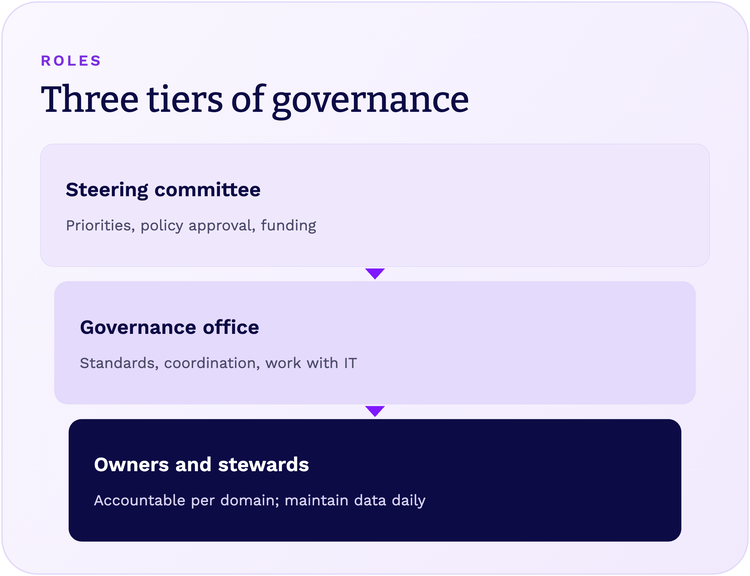
Governance is mostly a people problem, and most programs organize it in three tiers.
- Steering committee. Senior leaders who set priorities, approve policy and fund the program.
- Governance office. A small team that drafts standards, coordinates domains and works with IT.
- Owners and stewards. Business owners accountable for each domain, and stewards who maintain the data day to day, supported by data architects and analysts.
How to implement data governance
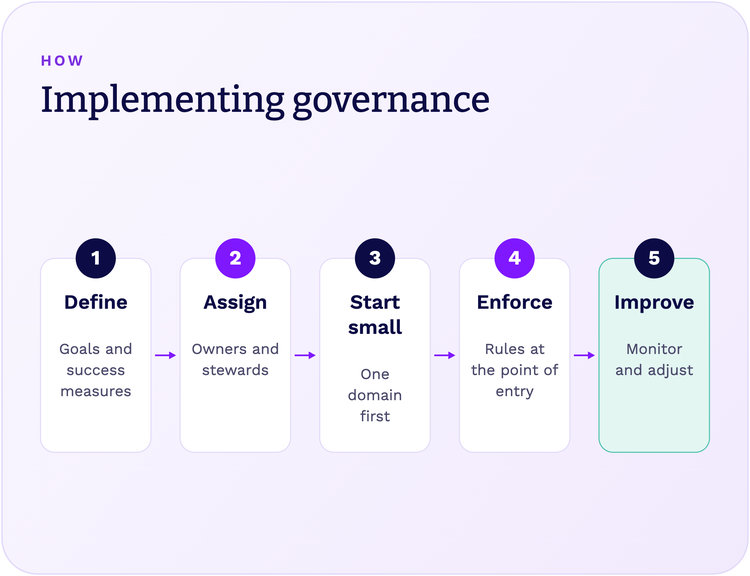
Large programs fail when they try to govern everything at once. Work in two phases.
Groundwork. Agree why governance matters and how success will be measured; decide who is accountable for what; and choose a first, limited scope, such as customer or product data.
Implementation. Make the in-scope data available in one place; agree formats and rules with the people who use it; assign an owner to every dataset and enforce policies at the point of entry; then monitor, collect feedback and adjust.
Common challenges and how to address them
- Low priority. People focused on daily operations undervalue data quality. Set a clear, practical goal that matters to them.
- Left to IT. IT runs the platform, but the business must define and enforce the rules.
- Silos and drift. Teams keep data in their own formats. Centralize shared data and build a lasting commitment to standards.
- Privacy. Broad access exposes sensitive data. Classify data by sensitivity, grant access by role, and use data only for the purposes it was collected for.
How EBX® puts governance into practice
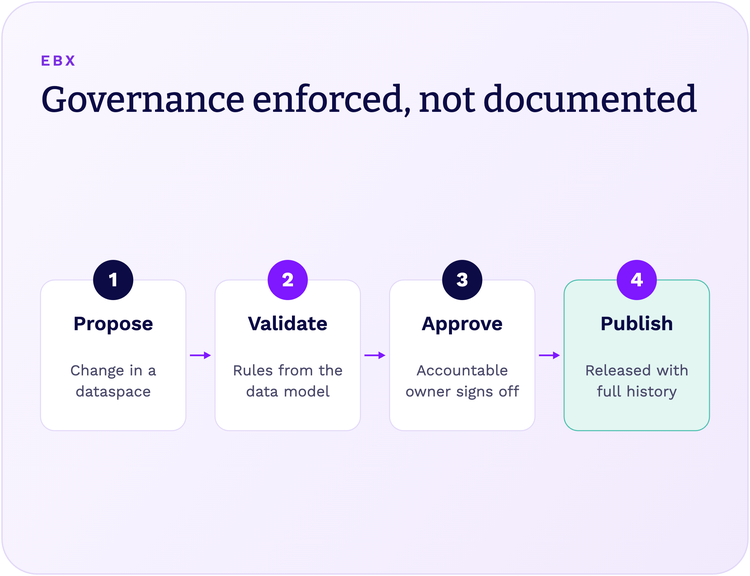
A rule that lives in a policy document is advisory. A rule enforced when data is entered is governance. EBX® makes governance operational for shared data:
- Role-based permissions down to the individual field.
- Workflows that route proposed changes to the accountable owner for approval.
- Dataspaces in which changes are prepared, compared and reviewed before publication.
- Validation rules defined in the data model and checked on every change.
- Full history, so every value can be traced to who changed it, when and why.
Frequently asked questions
What is the difference between data governance and data management?
Data management is the technical work of collecting, storing, integrating and delivering data. Data governance sets the rules, roles and decisions that work follows.
Who is responsible for data governance?
The business. Owners are accountable for each data domain and stewards maintain it, with IT providing the platform. A governance office coordinates across domains.
Where should a data governance program start?
With one high-value domain, such as customer or product, and a measurable goal. Extend to other domains once the first is working.
Make governance part of how data changes
Put owners, approvals, validation and history at the point where shared data is created and changed.
