
What are shared data assets?


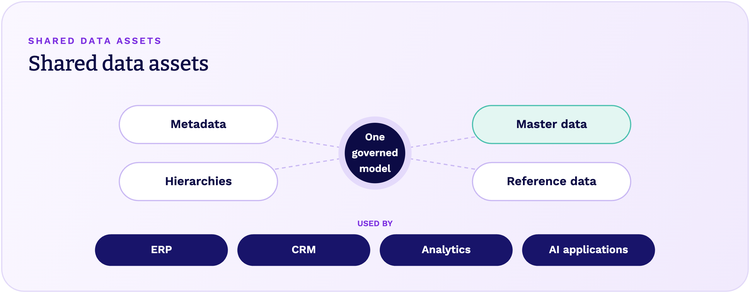
What counts as a shared data asset?
A data asset is shared when more than one system or team reads it, and a change to it matters to all of them. Four kinds of data meet that test in almost every organization.
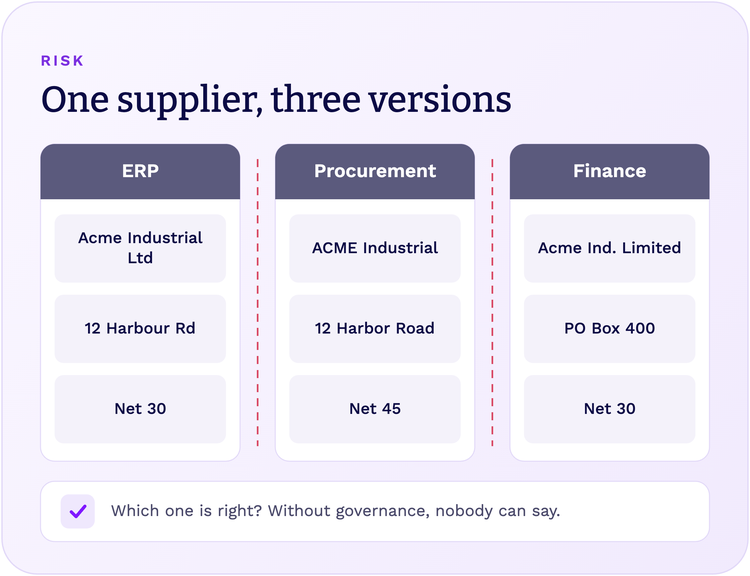
- Master data: the core business entities, such as customer, product, supplier and legal entity.
- Reference data: the permitted values those entities may take, such as country, currency and unit of measure.
- Hierarchies: the structures that organize entities into roll-ups, such as an org chart or a chart of accounts.
- Metadata: the definitions, ownership and lineage of all of the above.
Analytics teams add the conformed dimensions that let figures from different data marts be compared.
Shared data versus transactional data
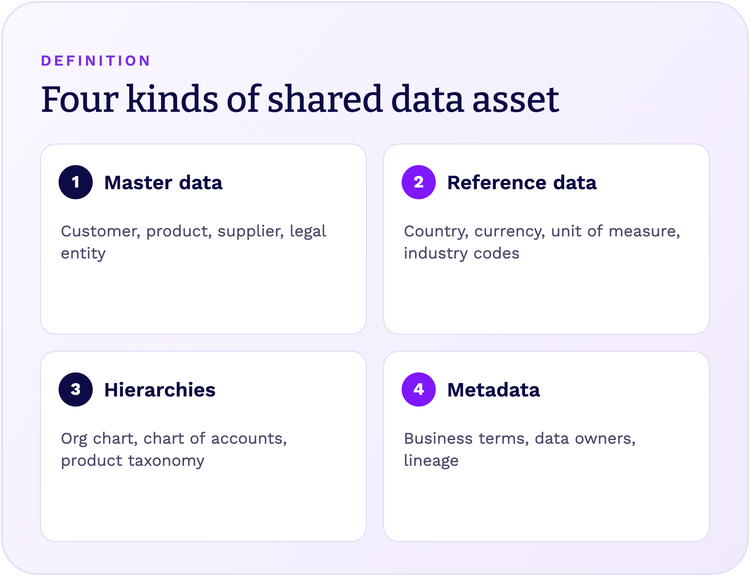
Most of an organization's data is transactional: orders, invoices, payments, shipments and claims. Each transaction belongs to the process that created it and is rarely changed afterwards. Shared data is different in three ways.
- It is referenced, not consumed. Thousands of transactions point at the same few shared records.
- It changes slowly, and each change spreads. A new tax class on a product affects every process that sells it.
- It has many users and no natural owner. Sales, finance and logistics all depend on the customer record, but none of their applications is responsible for it.
Transactional data can be managed inside the application that runs the process. Shared data cannot, because there is no single application in which to manage it.
What goes wrong when shared data is unmanaged
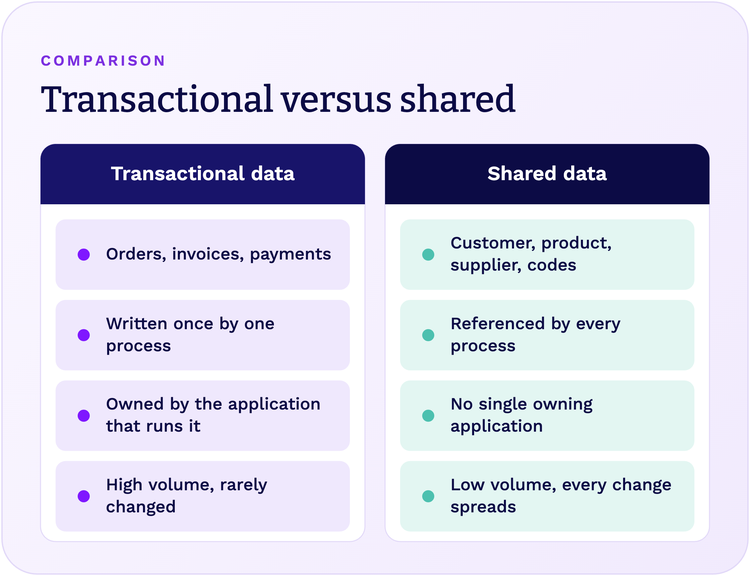
When there is no governed home for shared data, each application keeps its own copy and adds its own rules. The symptoms are familiar: the same customer exists five times with five addresses; one team adds a value to a code list and reports stop reconciling; a reorganization reaches the ERP but not the planning tool; and when a figure is disputed, nobody can show who changed the underlying data or why.
AI makes the problem sharper. Models and agents that read shared data inherit every inconsistency in it, and cannot reason reliably about a customer whose definition differs from one system to the next.
How do you manage shared data assets?
Managing shared data assets well comes down to four practices, whichever platform is used.
- Model them once. Define each asset, its attributes, permitted values and relationships in one model that every consumer uses.
- Govern change, not just content. Route every change through review by the people accountable for it, and keep the full history.
- Distribute the agreed version. Publish the approved record to the systems that need it instead of letting each system keep its own.
- Manage the assets together. A product record is only valid if its category exists in the taxonomy and its unit of measure is in the reference list. Separate tools break those links.
How EBX® manages shared data assets
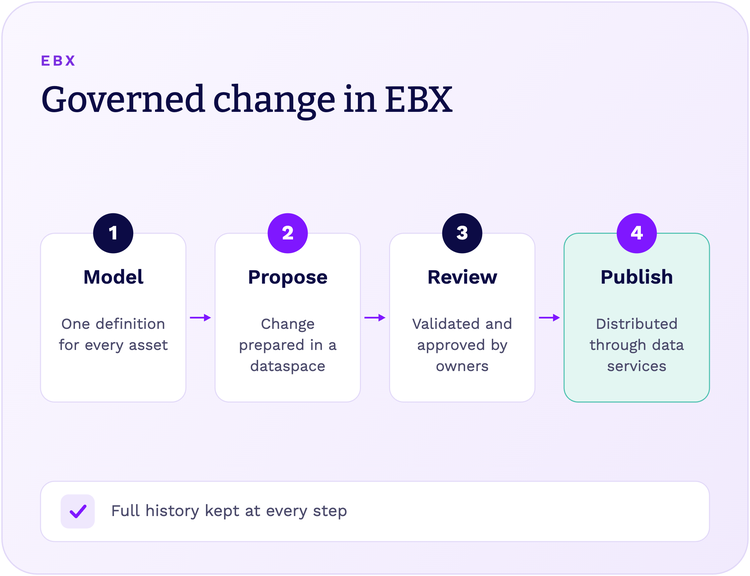
EBX® was designed to manage master data, reference data, hierarchies and metadata as shared data assets in a single platform, with one model and one governance layer.
- One model for every asset. Data models describe tables, fields, relationships, validation rules and permitted values together, and the user interface, validation and data services are generated from them.
- Dataspaces for safe change. A proposed change is prepared in isolation, compared with the version in force, reviewed and published as a unit.
- Workflows and permissions. Changes follow defined approval paths, and access is set by role down to the individual field.
- Full history. Every record carries what changed, when and by whom.
- Data services. Approved data reaches consuming systems through REST data services and other integration options.
Frequently asked questions
Are shared data assets the same as master data?
No. Master data is the largest kind of shared data asset, but reference data, hierarchies and metadata are shared too. Each depends on the others, which is why they are best managed together.
What is the difference between a shared data asset and a data product?
A data product is a packaged, consumable output built for a specific use. A shared data asset is the governed source that data products, applications and reports draw on.
Who owns shared data assets?
The business owns the decisions about what a valid record is and who may change it. Data stewards maintain the records day to day, and IT runs the platform and integrations.
Why do shared data assets matter for AI?
AI models and agents rely on shared data for context: which customer, which product, which legal entity. Governed shared data, with its definitions and lineage, gives them a reliable foundation.
Govern your shared data assets with EBX®
Bring master data, reference data, hierarchies and metadata into one governed platform, with the history and context your teams and your AI can trust.
