
What is a logical data model?


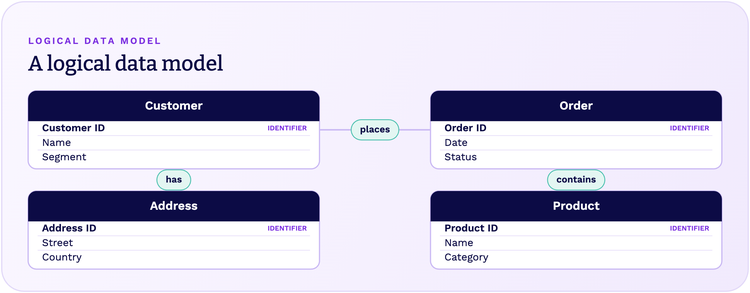
Components of a logical data model
- Entities: the things the business needs to record, such as customer, product or contract.
- Attributes: the facts recorded about each entity, with data types, lengths and precision.
- Relationships: how entities connect, including cardinality, such as one customer placing many orders.
Each component is named and defined in business language, so the model also documents the business rules it captures.
Conceptual, logical and physical models
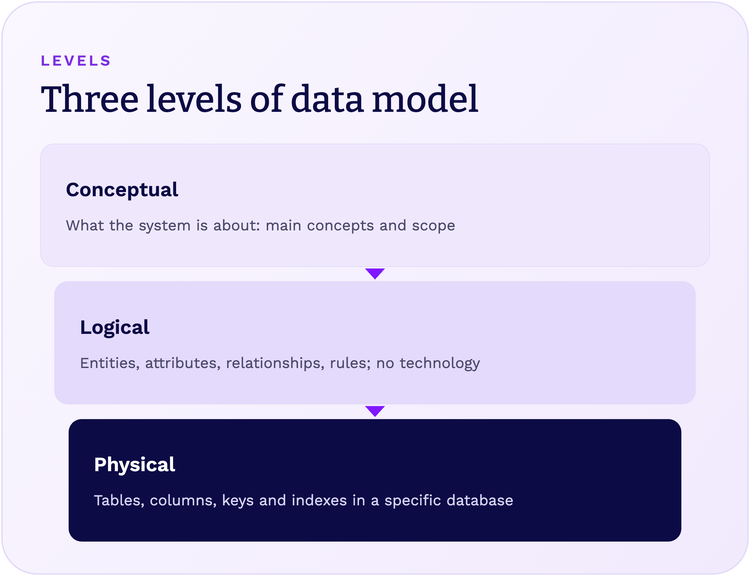
- Conceptual model: what the system is about. The main concepts and their scope, usually agreed by business stakeholders and data architects.
- Logical model: how the data is structured, independently of technology. Entities, attributes, relationships and rules, usually built by data architects and business analysts.
- Physical model: how a specific database implements it. Tables, columns, keys, indexes and storage, usually built by developers.
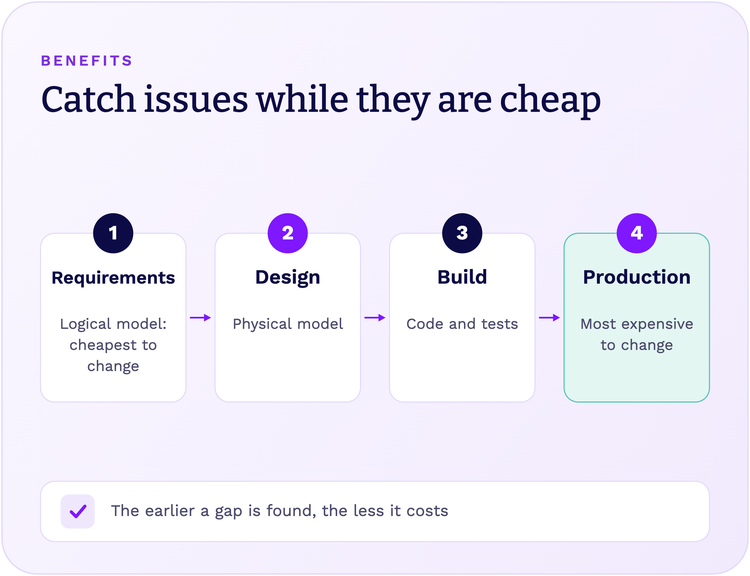
Conceptual and logical modeling are part of understanding requirements; physical modeling is part of design. The logical model is the bridge between them.
Characteristics of a good logical data model
- Independent of any database product or storage technology.
- Precise about data types, lengths and permitted values.
- Specific to the project's needs, but consistent with other models in the organization.
- Expressed visually, usually as an entity relationship diagram (ERD) or in UML.
- Defined in business language, so business users can review it.
Why build a logical data model
- Requirements are caught early, when changes are cheap, not after the database is built.
- Structures can be reused and shared across applications, reducing redundant data.
- Design, build and testing move faster because the rules are already clear.
- Impact analysis is possible, because rules and relationships are documented.
- Documentation stays readable, because definitions are in business language.
Skip it, and tables tend to be built around today's processes, with missing fields discovered late and legacy designs rebuilt on new platforms.
How EBX® uses data models
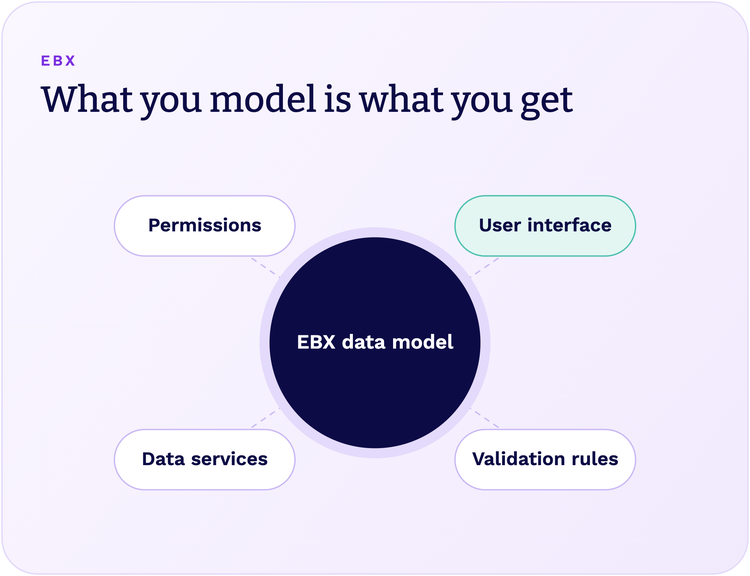
In EBX® the data model is not just documentation: it is the application. A model defines tables, fields, relationships, data types, validation rules, permitted values and hierarchies, and EBX generates the user interface, validation and data services from it. This approach, often summarized as "what you model is what you get", means that business rules agreed in the model are enforced on every record, and that changing the model changes the application without custom code.
Frequently asked questions
What is the difference between a logical and a physical data model?
A logical model describes entities, attributes and relationships independently of technology. A physical model describes how a specific database stores them, with tables, keys and indexes.
Does a logical data model include primary keys?
It identifies what makes each entity unique, but detailed key design, indexes and storage belong to the physical model.
Who creates a logical data model?
Usually data architects and business analysts, reviewed with the business owners whose rules it captures.
Turn your data model into a governed application
Define entities, rules and hierarchies once in EBX, and get the interface, validation and data services from the model.
