
What is metadata management?


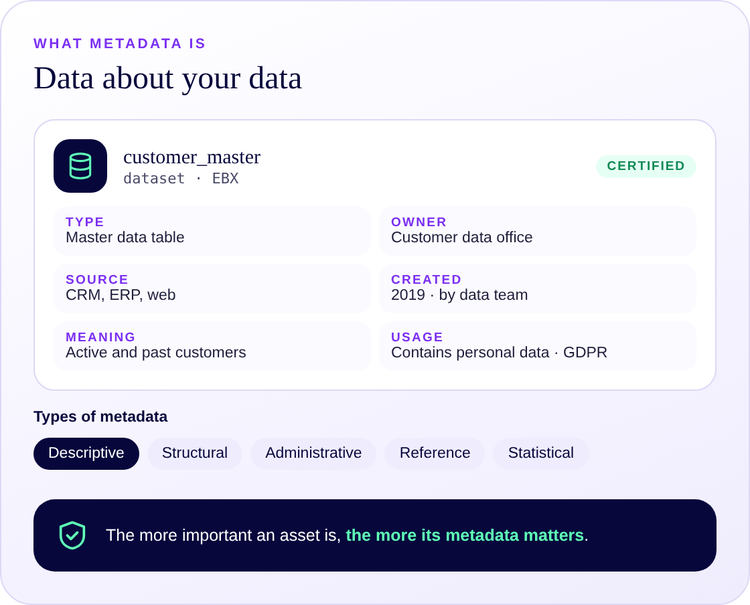
What metadata is
Metadata describes data: its type, when and by whom it was created, its size, its source, what it means and how it may be used. There are several types, including descriptive, structural, administrative, reference and statistical metadata. Metadata can be captured automatically or documented by people; the more important an information asset is, the more its metadata matters.
A solid metadata management strategy keeps data consistent and accurate across systems, makes decisions more reliable and is a core part of any data governance program.
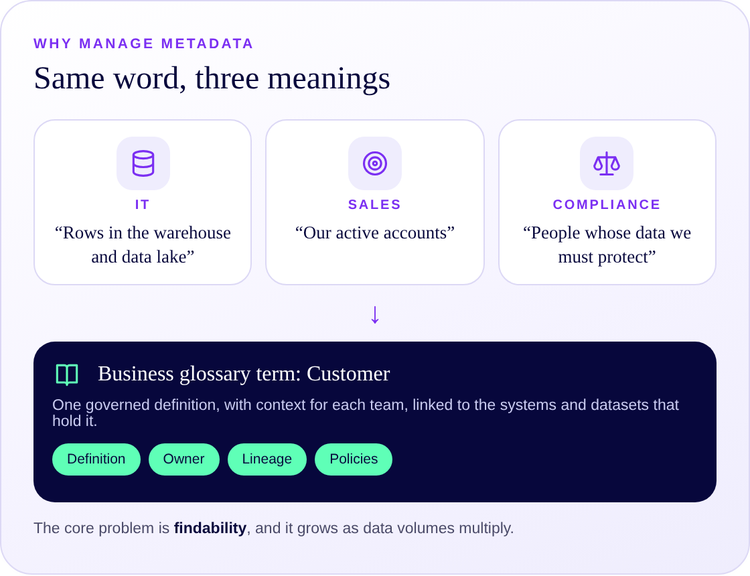
Why organizations manage their metadata
In most organizations, data is everywhere and little of it is catalogued. The core problem is findability, and therefore usability, and it grows as data volumes multiply.
Definitions also change with context. Ask IT, Sales and Compliance what a “customer” is and you get three answers: IT thinks of the warehouse and the data lake used for reporting; Sales thinks of active accounts; Compliance thinks of individuals whose personal data must be protected under regulations such as GDPR. The challenge is not just the definitions, but their inconsistency across teams and processes.
Metadata management gives each team the context it needs while keeping one consistent view of data across the organization.
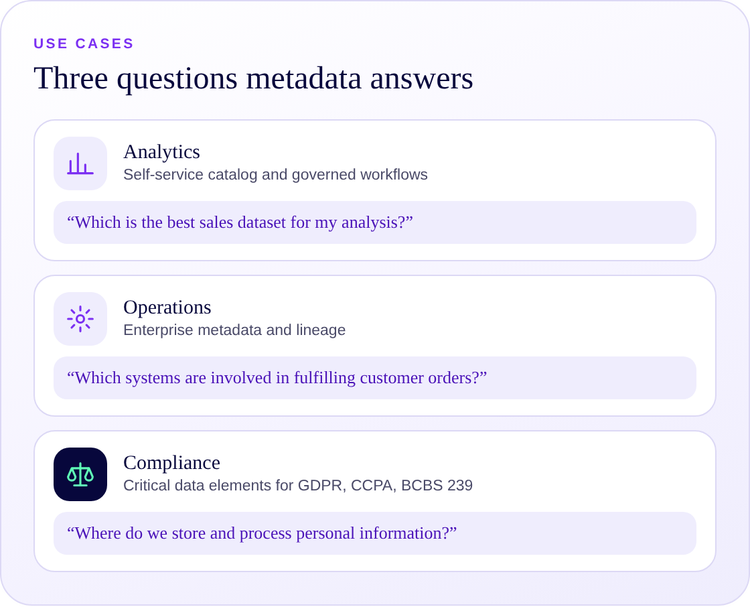
Metadata management use cases
- Analytics: find, understand and provision data through a self-service catalog and governed workflows. “Which is the best sales dataset for my analysis?”
- Operations: discover and manage enterprise metadata and lineage to improve operations. “Which systems are involved in fulfilling customer orders?”
- Compliance: identify critical data elements, document definitions and report on regulations such as GDPR, CCPA and BCBS 239. “Where do we store and process personal information?”
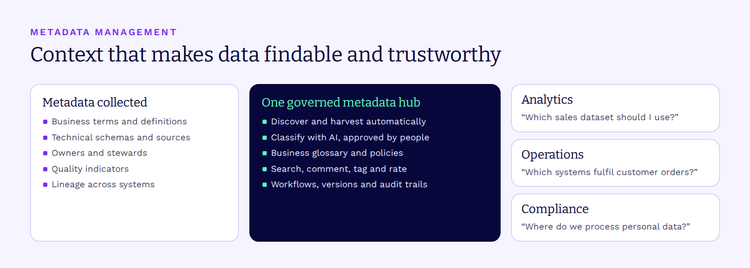
Capabilities to look for
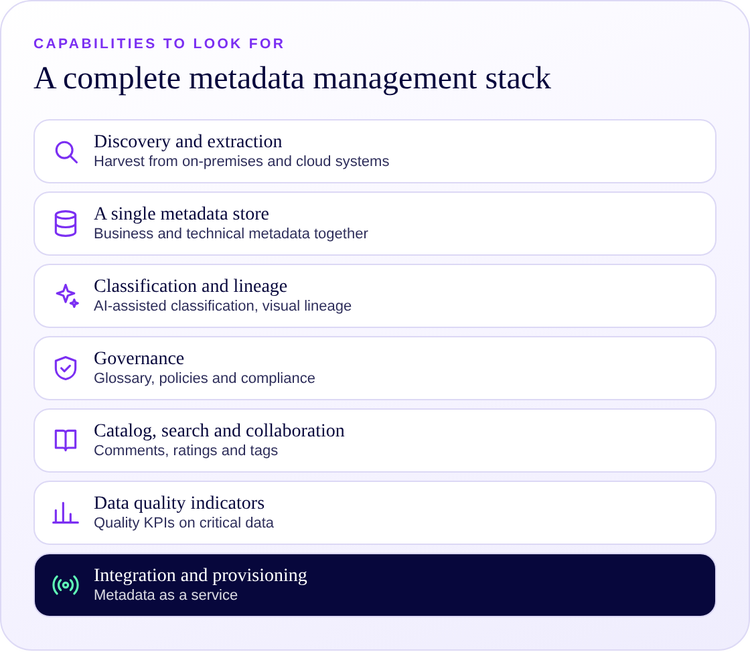
A complete metadata management solution captures and manages all metadata in one place:
- Discovery and extraction: harvest metadata automatically from on-premises and cloud systems.
- A single metadata store: business and technical metadata together, including glossaries, definitions and rules.
- Classification and lineage: AI-assisted classification of assets and visual lineage.
- Governance: business glossary, policies and regulatory compliance in one platform.
- Data catalog, search and collaboration: search across assets, with comments, ratings and tags.
- Data quality indicators: track quality KPIs on critical data.
- Integration and provisioning: expose metadata as a service and provision access through the catalog.
How metadata management fosters collaboration
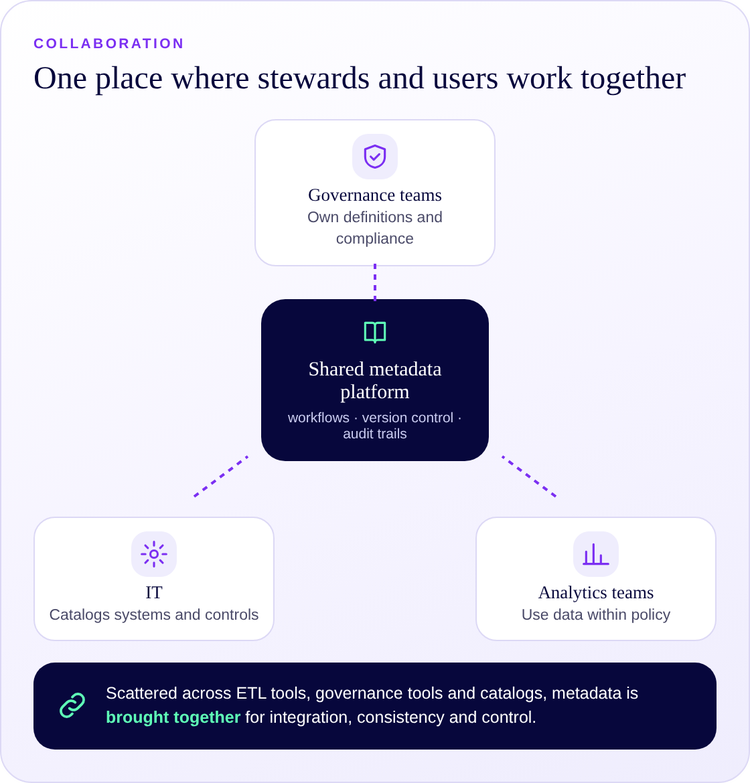
Data literacy is a team effort. Governance teams own definitions and compliance; IT catalogs systems and their controls; analytics teams consume data and must follow the policies the others set. They need one solution where data stewards and data users work together, with workflows, stewardship, version control and audit trails.
Metadata is often scattered across ETL tools, governance tools and catalogs that do not talk to each other. Bringing it together gives better integration, consistency and control.
Metadata management and AI
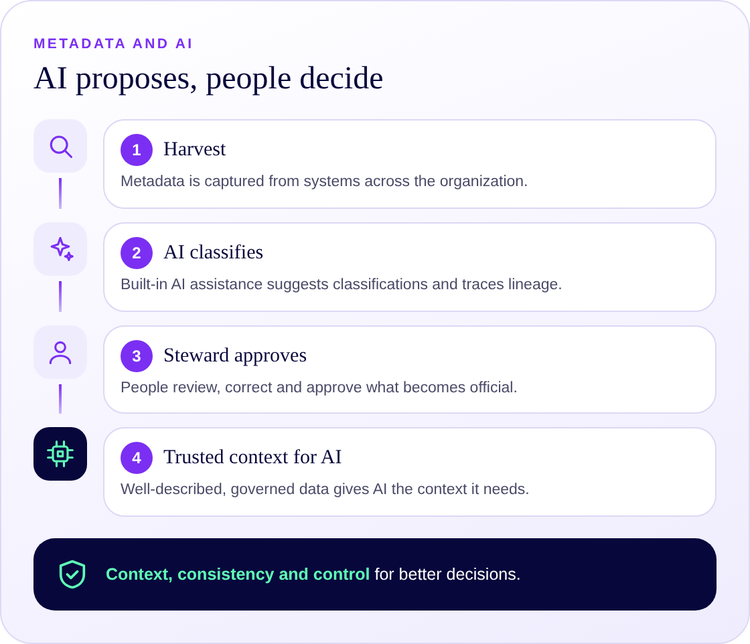
AI, edge devices and IoT are changing metadata management. Organizations increasingly use metadata to find more value in their data, and AI in turn depends on well-described, trusted data. Built-in AI assistance can classify metadata and trace lineage, while people stay in control of what is approved. The result is the context, consistency and control teams need for better decisions.
Govern master, reference and metadata with EBX®
Talk to our team about your master data goals, or explore how EBX® models, governs and shares master, reference and metadata in one platform.
