
What is data management?


Why data management matters
Most organizations have a data strategy; far fewer can say their data is treated as a business asset. The gap is usually not ambition but plumbing: the same customer defined differently in each system, reports that do not reconcile, and analysts who spend more time finding and fixing data than using it. Data management closes that gap by giving data owners, rules and a lifecycle.
Dimensions of data quality
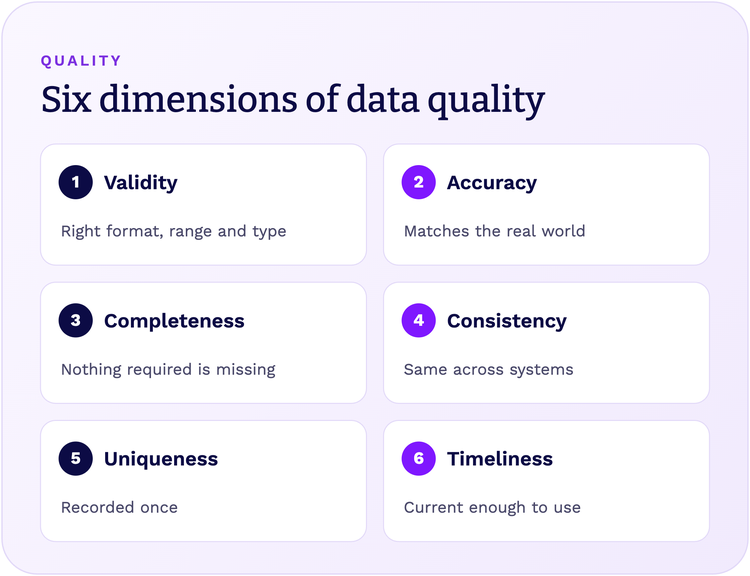
Every data management program is ultimately judged on the quality of the data it delivers. Six dimensions are widely used:
- Validity: values follow their defined format, range and type.
- Accuracy: values reflect the real-world thing they describe.
- Completeness: everything required is present.
- Consistency: the same item matches across systems.
- Uniqueness: each real-world entity is recorded once.
- Timeliness: data is current enough for its use.
Core data management disciplines
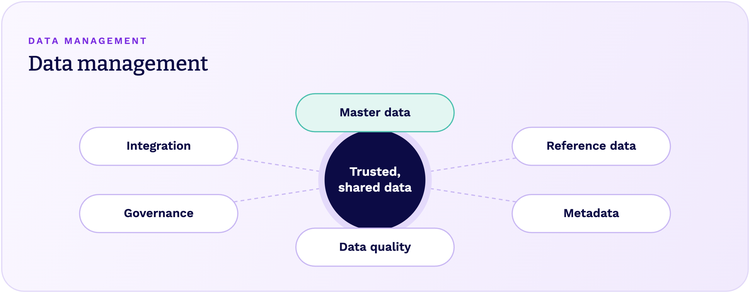
- Master data management: one governed version of core entities such as customer, product and supplier.
- Reference data management: governed code lists, classifications and hierarchies used across systems.
- Metadata management: definitions, ownership and lineage, often surfaced through a data catalog.
- Data quality: measuring and improving data against agreed rules.
- Data governance: the roles, policies and processes that decide how data is used.
- Data integration: moving and exposing data between systems, including virtualized access.
Common data management use cases
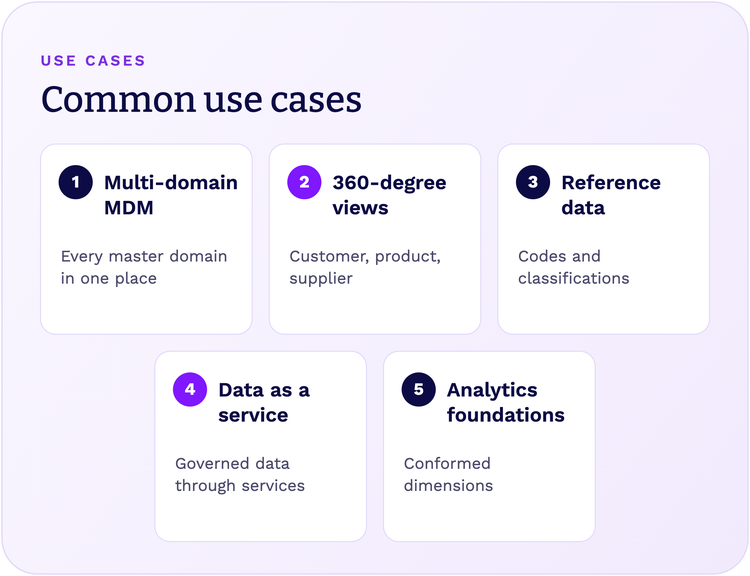
- Multi-domain MDM: customer, product, supplier and location governed in one platform.
- 360-degree views: one complete view of customers, products or suppliers.
- Reference data management: postal codes, cost centers and financial structures kept consistent everywhere.
- Data as a service: governed data offered to internal and external consumers through services.
- Analytics foundations: conformed dimensions that let data from different sources be compared.
Data management and data fabric
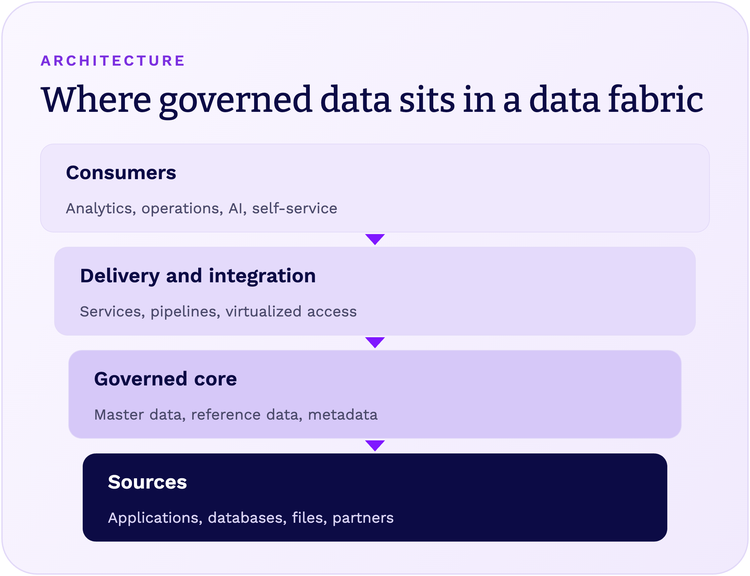
A data fabric is an architecture, not a product: a way of combining data management, metadata, integration and delivery so data from many sources can be found and used consistently across on-premises and cloud environments. Its value depends on the quality of the shared data assets underneath it. A fabric that delivers ungoverned customer or product data simply delivers inconsistency faster, which is why master, reference and metadata management sit at its core.
Where EBX® fits
EBX® manages the shared core of data management: master data, reference data, hierarchies and metadata, in one platform with one model, one governance layer and one history. It is where shared data is defined, validated, approved and published, so every other part of the data landscape starts from the same trusted records.
Frequently asked questions
What is the difference between data management and data governance?
Data management is the work of handling data across its lifecycle. Data governance is the set of rules, roles and decisions that work follows.
What is the difference between data management and master data management?
Master data management is one discipline within data management, focused on the core entities, such as customers and products, that many systems share.
Is a data fabric a product?
No. A data fabric is an architecture that combines data management, metadata, integration and delivery. Several products usually contribute to it.
Start with the data everything else depends on
Govern master data, reference data and metadata in one platform, and give every system the same trusted foundation.
