
Governance is broader than just MDM
A pristine “golden record” is useless if the systems downstream misinterpret its meaning. Trusted operations depend on shared definitions, classifications, reporting hierarchies and business metadata.
If your reference data lives in spreadsheets, your metadata in a disconnected catalog and your master data in a separate hub, you do not yet have governance. You have three systems that disagree.
Govern the data and its metadata in one place
Because EBX® is natively a master data and reference data management platform, it does not merely read metadata from somewhere else. You author, govern and steward the data and the metadata that describes it in the same interface, under the same permissions, validation rules, workflows and history.
The catalog documents applications, datasets and data elements as logical descriptions, and those descriptions can exist before the thing they describe does.
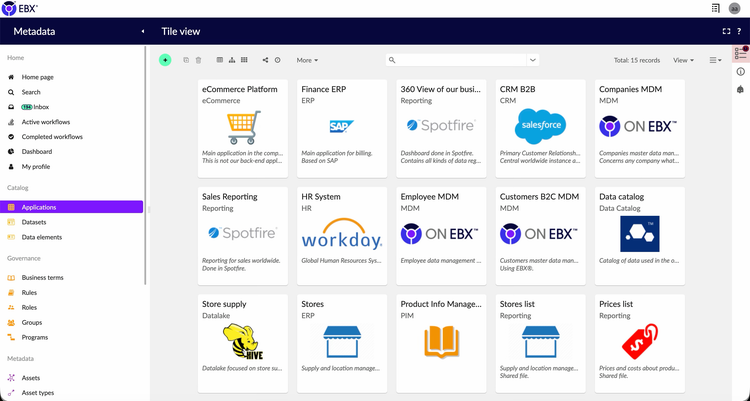
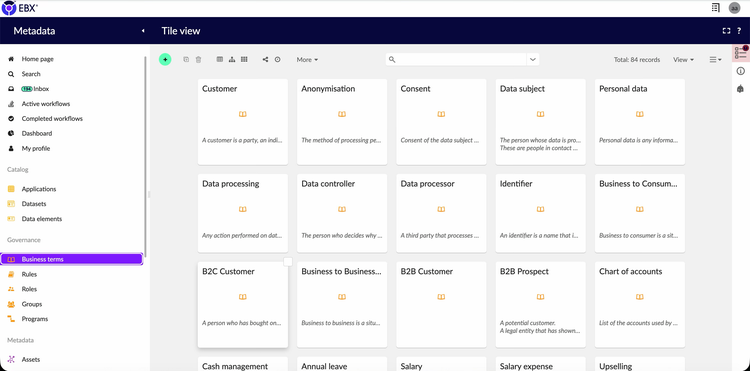
Glossaries, ontologies and taxonomies
A business term carries its definition, the domain that owns it and its relationships to other terms. Terms arrange into taxonomies and connect into a semantic ontology, so a reader sees how concepts relate instead of reading definitions in isolation.
Defined once and reused everywhere, rather than re-argued in every project.
One catalog, four lenses
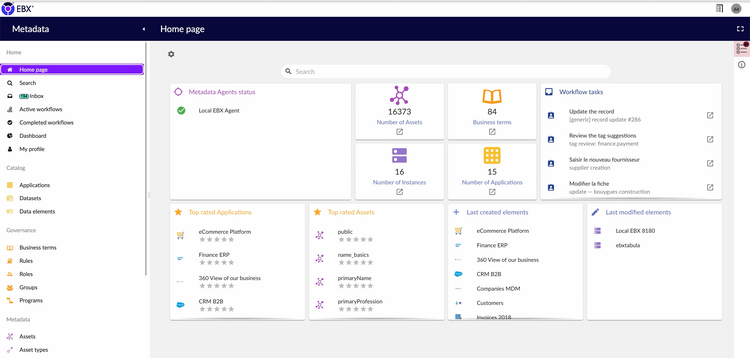
Go beyond a list of assets. EBX® unites the technical view with business definitions and analytical context, so the catalog answers the questions people actually ask: where the information is, what it means, where the analysis happens, and what they already have access to.
Technical metadata: systems, instances and physical structures.
Governance: business glossary, ontologies, owners and policies.
Analytics and reporting: models, hierarchies and report impact.
Business-oriented: self-service datasets, usage and entitlements.
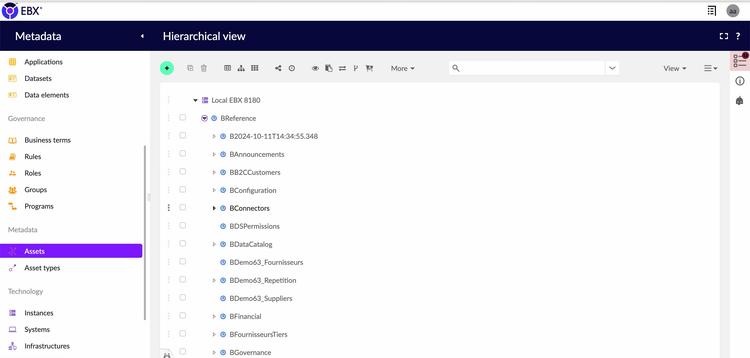
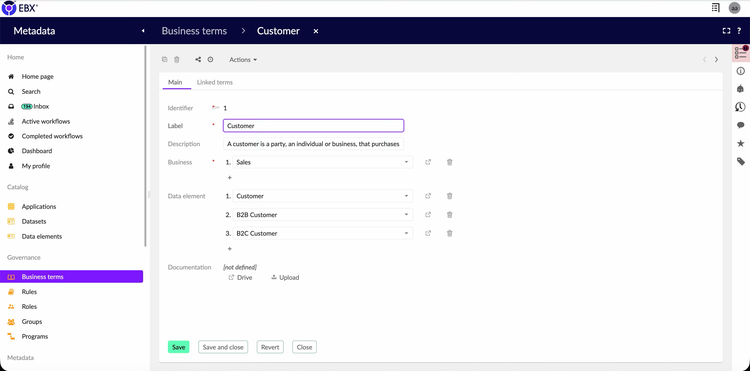
Where business meaning meets technical reality
A data element is the business concept. An asset is the physical column, table or file that realises it. Classification is the join between them, and EBX® proposes the match with a confidence score rather than leaving it to manual mapping.
That one link is what lets a business term resolve to real columns in a real database, and what makes impact assessment possible before a change is made rather than after something breaks.
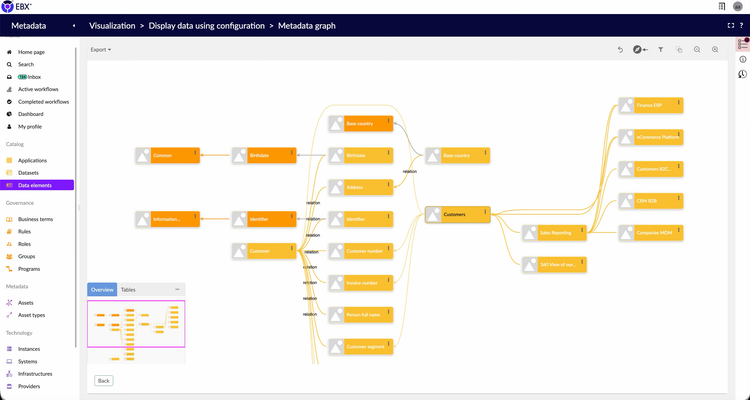
Lineage and interconnectivity
Cataloguing is not about finding files. It is about understanding how mappings create value.
Horizontal: system-to-system flows across the landscape.
Vertical: conceptual to logical to physical.
Report: source through to the analytical model.
Taxonomic: attribute-driven hierarchies.
Stewardship that cannot be skipped
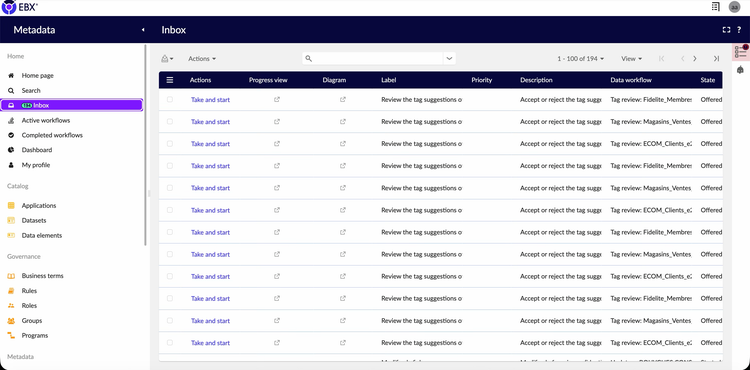
Permissions decide who may create and change each kind of record. Collaborative workflows decide what must happen before a change becomes real: creation or update, review, approval (in parallel tracks where the policy calls for it) and finalisation.
Governance stops being a document describing how things ought to work, and becomes the path the work actually takes.
Why this matters for analytics and AI
Without a connected governance structure, dashboards disagree about the numbers and AI systems lose operational context the moment they meet contradictory reference codes.
Trusted outputs depend on trusted, shared, operationalised definitions, governed in the same model as the data they describe.
Metadata and governance: common questions
What is the difference between business and technical metadata?
Business metadata describes what data means to the organisation: terms, definitions, ownership, policies. Technical metadata describes where it physically lives: systems, instances, tables, columns and the flows between them. EBX® holds both, and links them through classification. Learn more: What is metadata management?
Is this a separate catalog product?
No. Metadata management is part of EBX®. Because the platform is natively an MDM and RDM system, metadata is authored and governed in the same model as master data, reference data and hierarchies, not observed from the outside by a separate tool.
How does a business term connect to real data?
Through classification. A business term relates to a data element, and a data element is matched to the asset (the physical column or table) that realises it. EBX® suggests those matches with a confidence score.
What kinds of lineage does EBX® support?
Horizontal system-to-system flows, vertical conceptual-to-logical-to-physical mappings, report-to-source provenance, and taxonomic attribute-driven hierarchies.
How is stewardship enforced?
Through permissions on each entity and collaborative workflows per operation: creation or update, review, approval (which can run as parallel tracks) and finalisation. Related: What is master data management?
Validate the governance model
See how EBX® unites business glossaries, active data dictionaries and master data stewardship in a single governed repository.
