
What is unified data management?


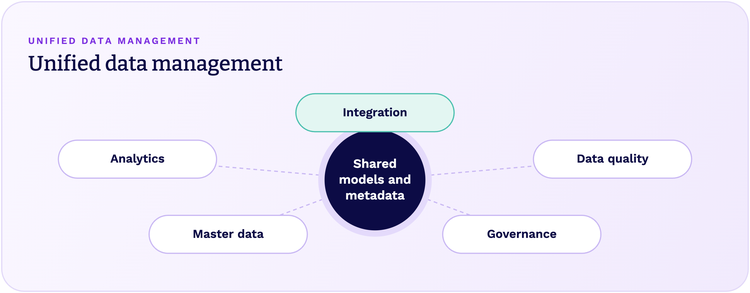
What unified data management looks like
UDM is not an off-the-shelf product. It is a way of organizing several disciplines so they share the same foundations: one definition of each business entity, one place where rules are maintained, and metadata that every tool can read.
Picture a retailer that brings customer, marketing, sales and web analytics data together on shared definitions. It can finally see that customers browse on mobile and buy on desktop, which product pairings sell, and which channels it had wrongly written off, and act on all three.
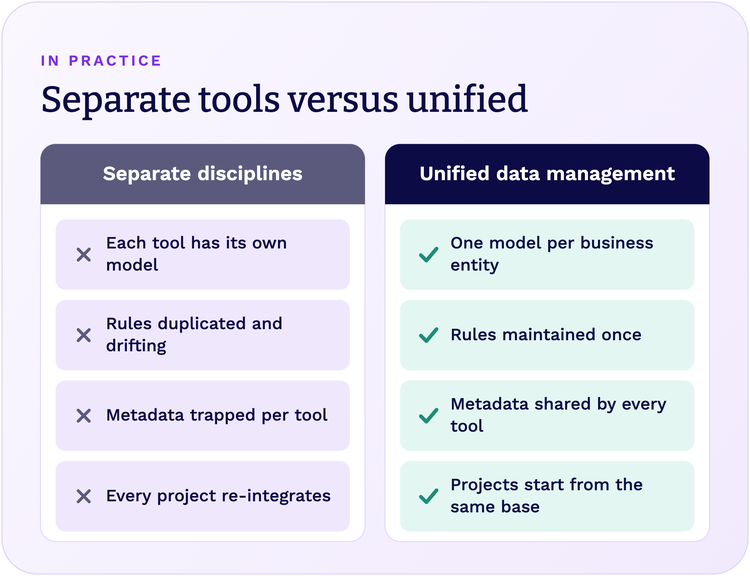
Why organizations pursue unified data management
- Access: people can find accurate data for ordering, invoicing or claims without hunting across systems.
- Accurate analytics: insight built on complete, consistent data rather than on whichever extract was available.
- Less overload: each item is held and maintained in one governed place.
- Compliance: rules are applied consistently, and changes are traceable.
- Lower cost: fewer duplicate datasets, fewer reconciliations, less time spent preparing data.
Unified data management by other names
Many organizations practice unified data management without calling it that.
- Enterprise data management (EDM) and enterprise information management (EIM) describe similar ambitions, often with a narrower scope.
- Master data management concentrates on the accuracy and accountability of shared entities, and is usually the core that UDM is built around.
- Data governance sets the rules and roles UDM follows, but is not itself a management system.
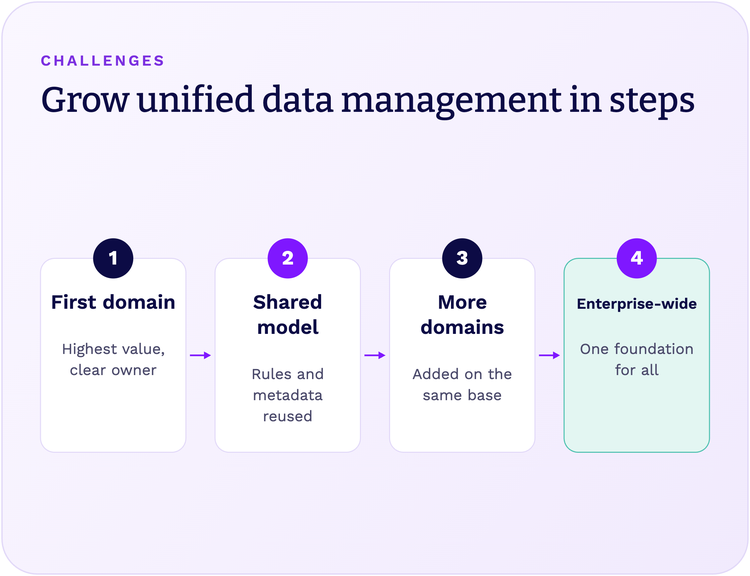
Challenges and how to avoid them
- Scope too broad. Trying to unify everything at once fails. Start with a few high-value domains and grow incrementally.
- Rigid architecture. Sources, volumes and types change. Let business needs drive the architecture, and avoid structures that cannot evolve.
- Unclear standards. Involve governance, IT and business owners from the start, and give personal data special attention.
- Data nobody understands. Stored data that cannot be found or interpreted is a cost. Invest in metadata and a catalog.
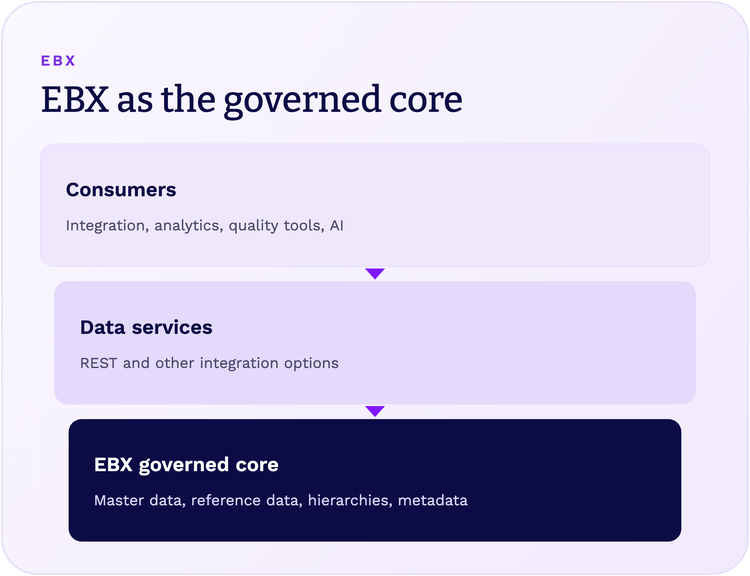
How EBX® supports unified data management
EBX® provides the governed core that unified data management is built around: master data, reference data, hierarchies and metadata in one platform, with one modeling approach, one governance layer and one history. Integration, quality and analytics tools connect to it through data services, so they consume the same governed definitions instead of maintaining their own.
Frequently asked questions
Is unified data management a product?
No. It is an approach that connects several data management disciplines around shared models and metadata. Several products usually contribute to it.
How is unified data management different from master data management?
Master data management governs the shared entities themselves. Unified data management connects MDM with integration, quality, governance and analytics so they all use the same definitions.
Where should unified data management start?
With one or two high-value domains and the shared model and metadata for them. Add domains on the same foundation as the program proves its value.
Build unified data management on a governed core
Start with master data, reference data and metadata in one platform, and connect every other discipline to it.
