
What is multi-domain MDM?


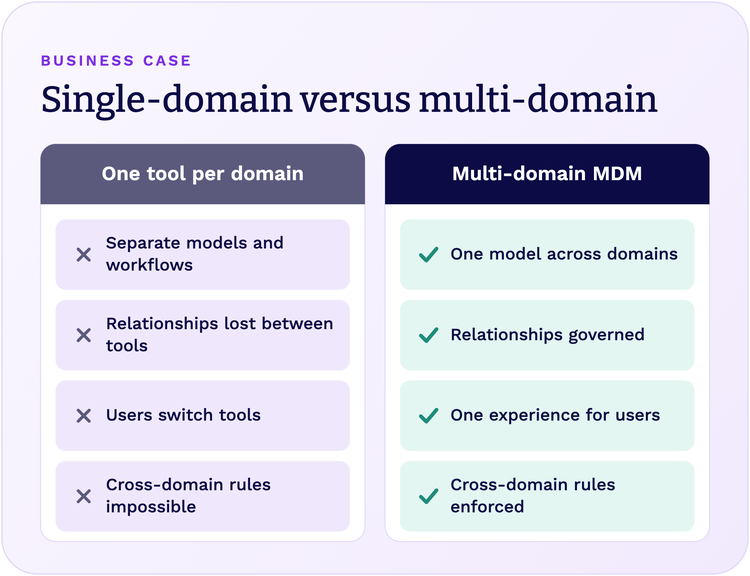
The business case for multi-domain MDM
- Model any master data, including the relationships between domains, without buying a separate tool per domain.
- One set of capabilities, such as workflow, validation, stewardship and history, configured once and reused.
- One experience for business users, who need to work across domains without switching tools.
- Cross-domain rules, such as a product that may only be sold in a country where it is registered, can be enforced at all.
The waste that poor master data creates
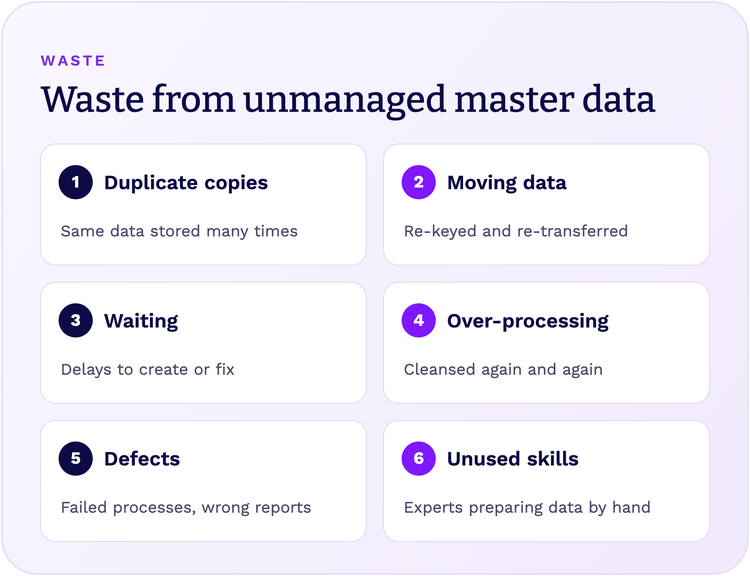
A useful way to see the cost of unmanaged master data is through the classic categories of waste:
- Inventory: duplicate copies of the same shared data.
- Transport and motion: moving the same data between tools and re-keying it into several systems.
- Waiting: delays for data to be created, corrected or approved.
- Over-processing: cleansing and checking the same data repeatedly.
- Defects: failed processes, wrong reports and compliance findings.
- Unused skills: experts spending their time preparing data by hand.
What to look for in a multi-domain MDM platform
- Configurable, not fixed. The platform adapts to your data model, not the other way round.
- Usable by the business. Stewards and subject matter experts can work without developer help.
- Complete. Modeling, validation, workflow, hierarchies, history and data services in one place.
- Built for iteration. New domains and attributes can be added in short cycles.
- A proven vendor. Long MDM experience, a clear roadmap, global support and customers across several use cases.
A typical multi-domain problem
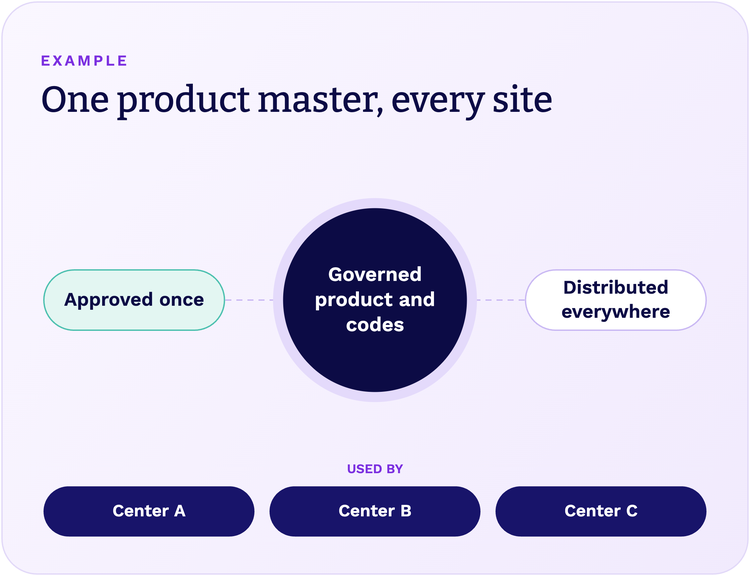
Consider an organization with several distribution centers, each translating product and classification codes in its own way. Inventory counts disagree between centers, approvals for new codes take weeks, and nobody has one list of what is in stock. The fix is not a better report: it is one governed product master and one set of classification codes, approved once and distributed to every center, so they stop doing their own translations.
How EBX® delivers multi-domain MDM
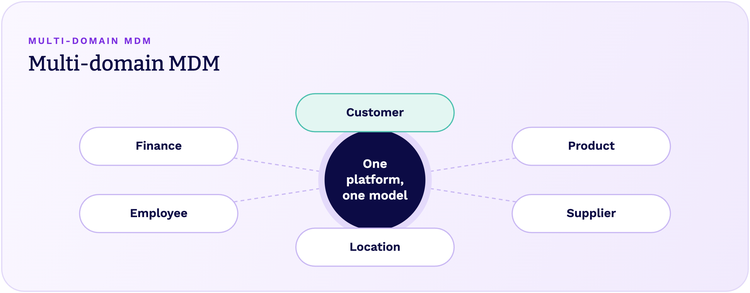
EBX® was built as a multi-domain platform. Customer, product, supplier, location, finance and any other domain are modeled in the same way, with relationships between them, and governed by the same permissions, workflows, dataspaces, validation and history. Reference data and hierarchies live in the same models as the master data that uses them. New domains are added by extending the model, not by adding a tool.
Frequently asked questions
What is a master data domain?
A category of master data that the business manages as a unit, such as customer, product, supplier, location, employee or finance.
Should we start with one domain or several?
Start with the domain that delivers the clearest value, on a platform that can add the next ones without starting again.
How is multi-domain MDM different from a data warehouse?
A warehouse consolidates data for analysis. Multi-domain MDM governs the operational master records that every system, including the warehouse, uses.
Govern every master domain in one platform
Model customer, product, supplier, location and finance data together, with one governance model and one history.
