
What is reference data?


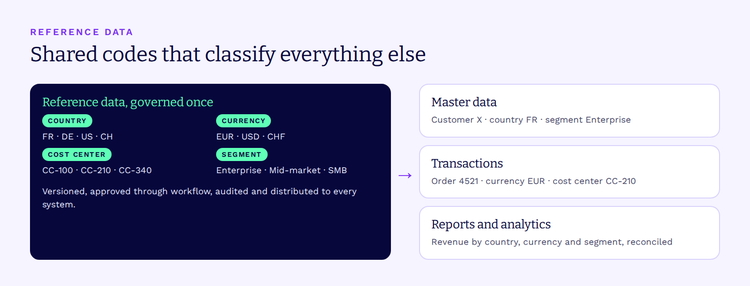
Understanding reference data
Reference data is a special subset of master data used for classification throughout the organization. It defines the allowed values for an identifier and includes code lists, complex hierarchies and mappings. It can come from inside the organization or from external sources, and it can be organized as one-to-one relationships, one-to-many relationships or hierarchies.
Industry analysts describe two main kinds:
- Multi-domain reference data is not industry specific. It spans functions such as finance, risk, compliance and human resources, and content such as ISO country codes.
- Real-time reference data is used in capital markets and in command and control environments, and increasingly to tag streaming IoT data.
Reference data can be public or private. It connects domains and applications through consistent values and meanings, for example cost and revenue accounts, sales teams, business units, geographies or industry codes that link customers and products.
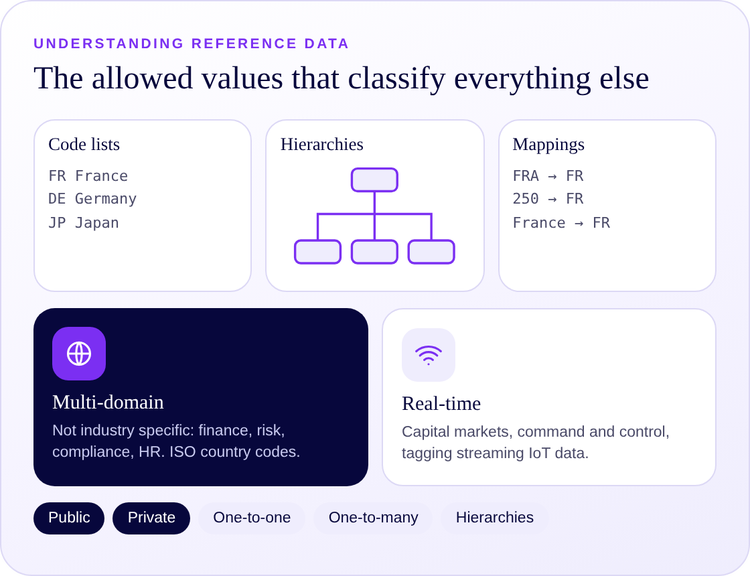
Reference data vs. master data
Master data describes the key entities of the business, such as customers and products. Reference data is the set of permissible values used to classify that master data. Reference data changes slowly, reflecting changes in business rules; master data changes within everyday business processes. Because reference data changes rarely, small changes are easy to miss, yet they must be governed and synchronized everywhere. That is why organizations need consistent reference data management and governance.
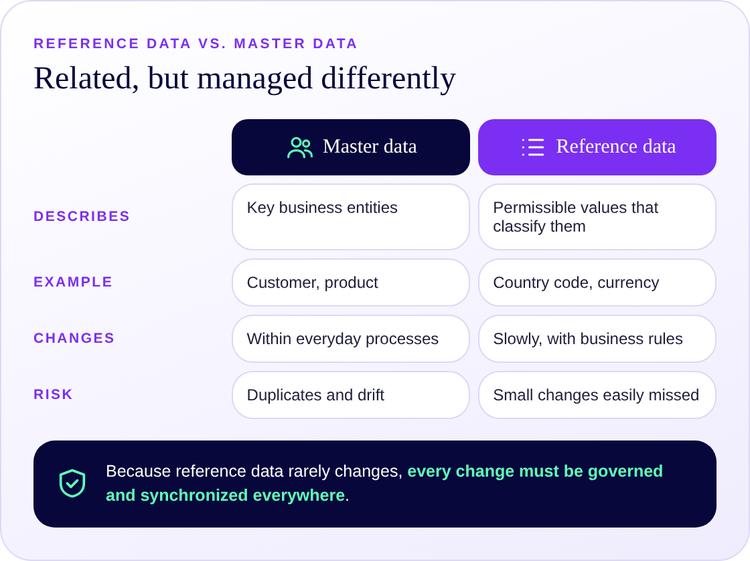
Examples of reference data
- Postal codes
- Country and state codes
- Currencies
- Language codes
- Transaction codes
- Cost centers
- Financial hierarchies
- Organizational unit types
- Customer segments
- Tasks and business processes
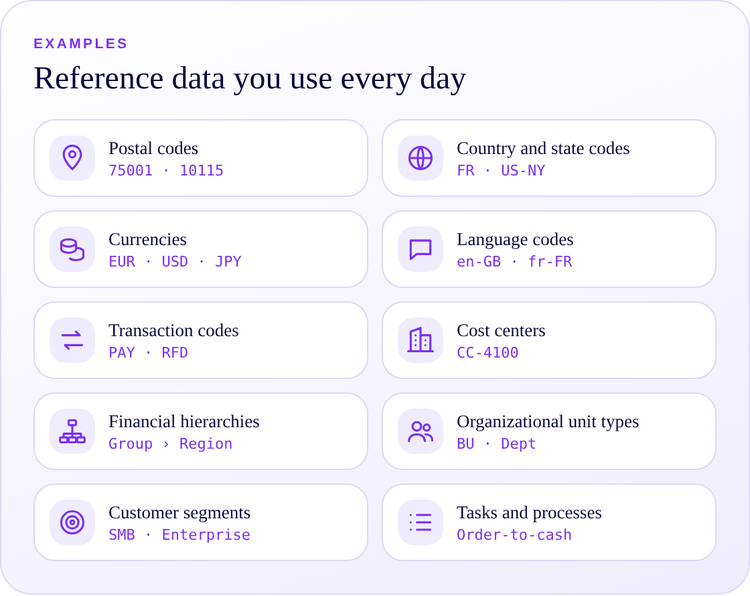
Why reference data management matters
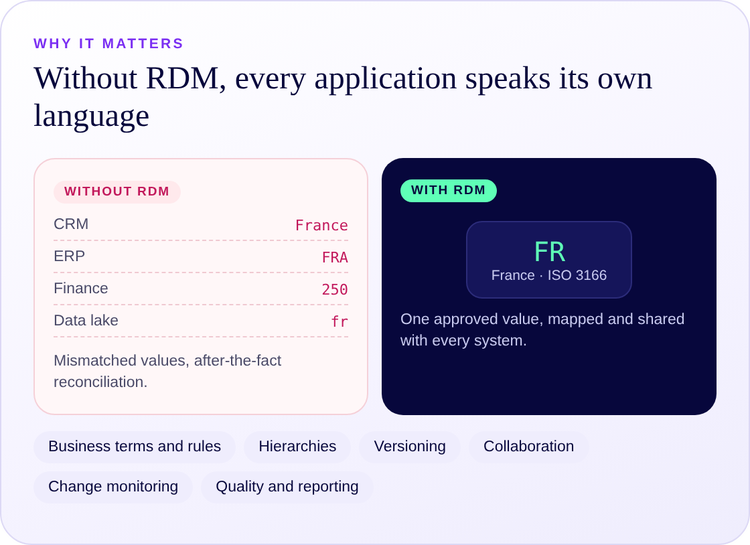
Reference data connects domains and applications, so managing it raises governance, versioning and custom hierarchy questions. Reference data management (RDM) defines values against business terms and rules, manages hierarchies, supports collaboration and monitors changes, quality and reporting.
Without it, each application defines reference data its own way. Teams and systems end up using mismatched values across regions, currencies, product lines and accounts, and the organization pays for after-the-fact reconciliation.
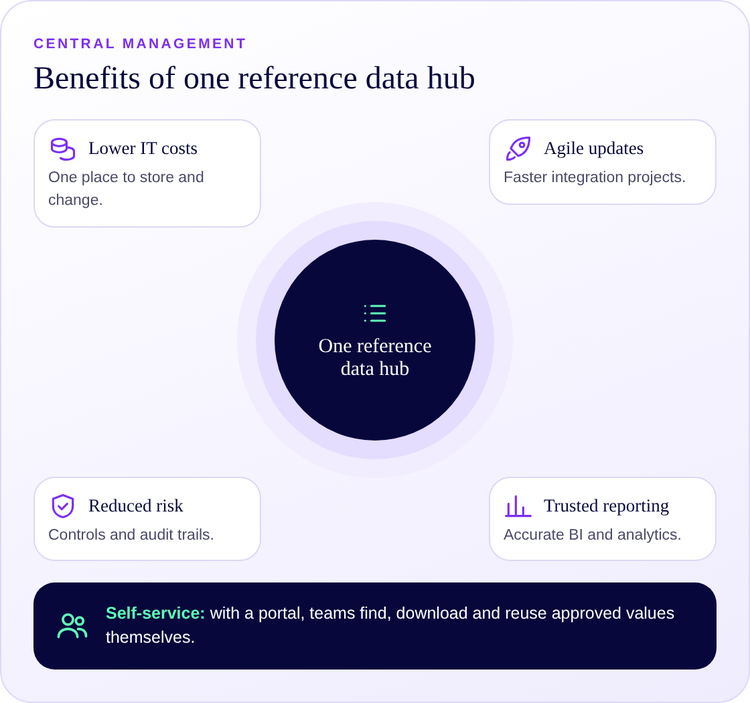
Benefits of managing and distributing reference data centrally
- Lower IT costs: one place to store and change reference data instead of many.
- Agile updates: less effort to change values, and faster integration projects.
- Reduced risk: controls and audit trails on changes prevent decisions and regulatory reports based on inconsistent data.
- Trusted reporting: consistent reference data makes BI reports and analytics accurate.
- Self-service: paired with a portal, an always-current repository lets teams find, download and reuse approved values.
Who relies on reference data?
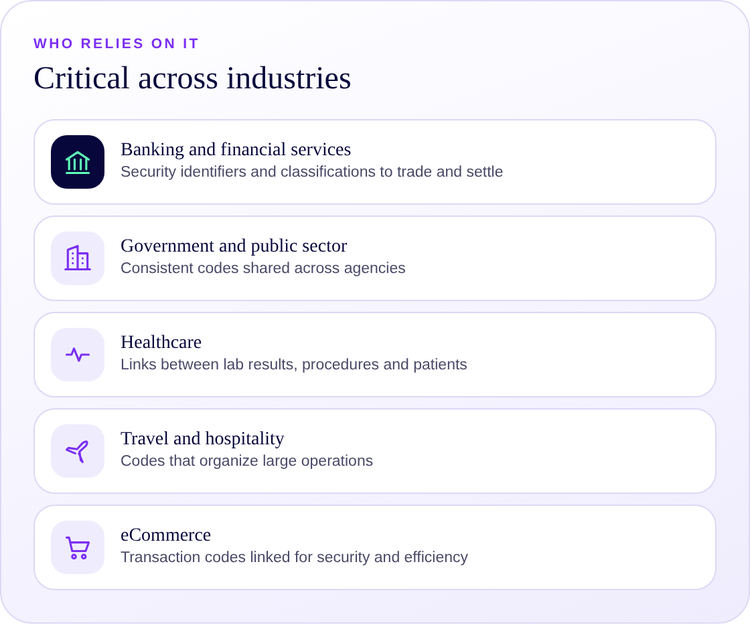
Every organization has reference data. It is especially critical in:
- Banking and financial services: security identifiers and classifications used to trade and settle.
- Government and public sector: consistent codes for public records shared across agencies.
- Healthcare: accurate links between lab results, procedures and patient information.
- Travel and hospitality: codes that organize large operations and customer experiences.
- eCommerce: transaction codes and customer information linked consistently for security and efficiency.
Manage reference data with EBX®
Talk to our team about your master data goals, or explore how EBX® models, governs and shares master, reference and metadata in one platform.
