
What is data cleansing?


Where dirty data comes from
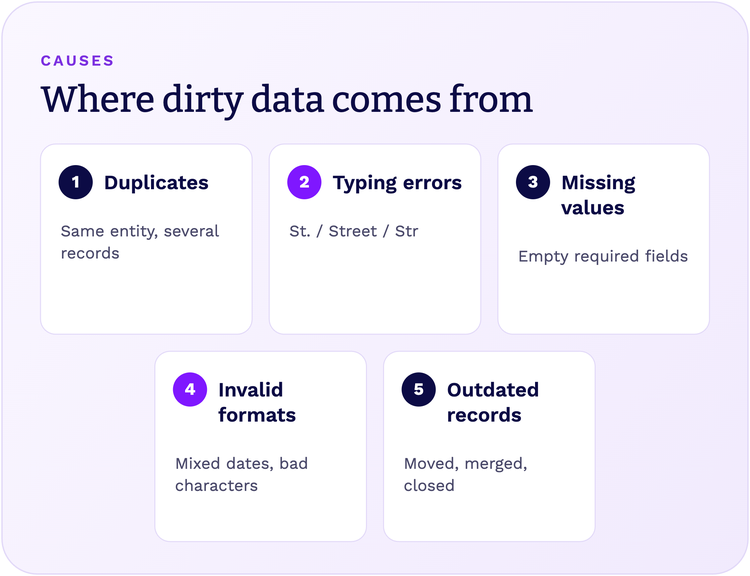
- Duplicates created when the same customer or product is entered in several systems that are never matched.
- Typing errors and inconsistent entries, such as "Street", "St." and "Str" for the same thing.
- Missing values in fields that were optional when they should not have been.
- Invalid characters and formats, such as letters in a phone number or dates in mixed formats.
- Outdated records that were right once, such as a customer who moved or a supplier that was acquired.
Data cleansing techniques
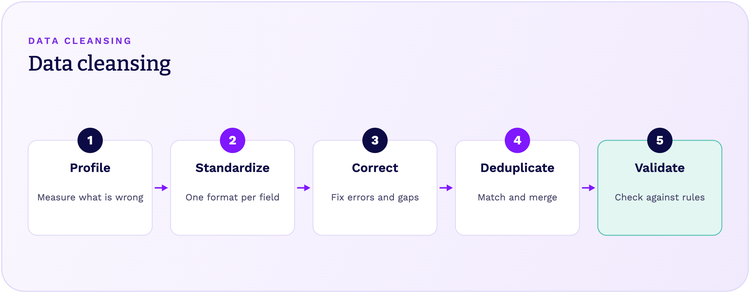
- Rule-based correction. Apply defined rules for formats, ranges and permitted values.
- Standardization and parsing. Split and normalize names, addresses and codes so they can be compared.
- Matching and merging. Identify records that describe the same entity and combine them into one.
- Statistical outlier detection. Flag values far from the norm using averages, ranges and standard deviation. Fast, but prone to false alarms.
- Pattern-based detection. Find values that break the pattern of their field, using clustering or classification.
- Association rules. Flag records that break known if-then relationships, such as a postcode that does not belong to the stated city.
Prevent bad data at the point of entry
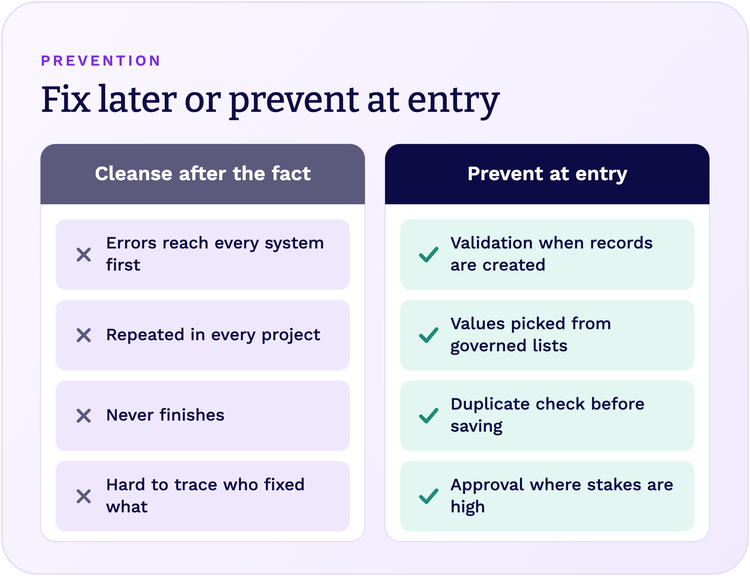
Cleansing after the fact is expensive and never finishes. The cheapest fix is to stop bad data getting in:
- validate formats, ranges and required fields when a record is created;
- select values from governed reference lists instead of typing them;
- check for likely duplicates before a new record is saved;
- route new and changed records to a steward for approval where the stakes are high.
Cleansing then becomes the exception handler, not the operating model.
How EBX® keeps shared data clean
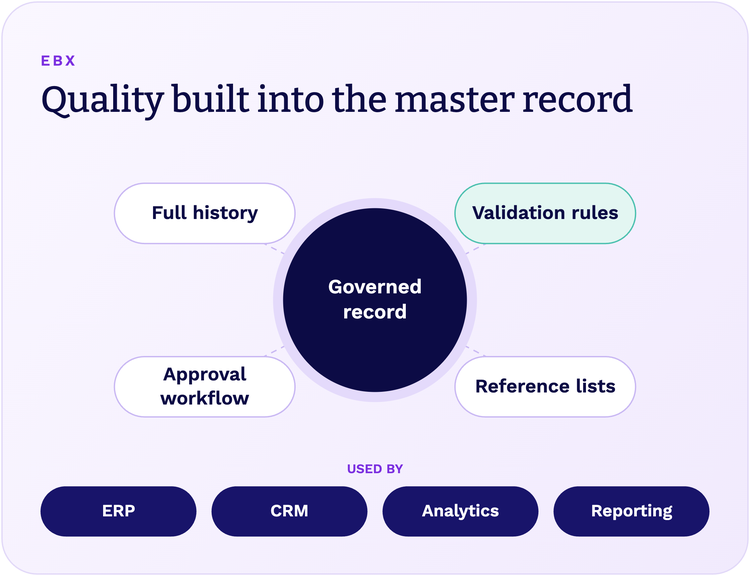
EBX® applies data quality where it costs least: at the point of entry into the master record. Validation rules and constraints defined in the data model are checked whenever a record is created or changed; permitted values come from governed reference data; workflows route new and changed records for review; and every correction is kept in history, so it is clear who fixed what and when. Clean master data is then published to the systems that use it, so they stop having to clean it themselves.
Frequently asked questions
Is data cleansing the same as data quality?
No. Data quality is the condition of the data, measured along dimensions such as accuracy, completeness and consistency. Data cleansing is one activity that improves it.
Can data cleansing be fully automated?
Much of it can, but not all. Automated rules can merge records that should stay separate or remove genuine outliers, so stewards still need to review the exceptions.
How often should data be cleansed?
Continuously. Data changes every day, so one-off cleanups go stale. Validating at entry and monitoring quality over time works better than periodic projects.
Stop bad data at the source
Validate shared data when it is created, govern every change, and publish clean records to every system that depends on them.
