
Small data, big consequences
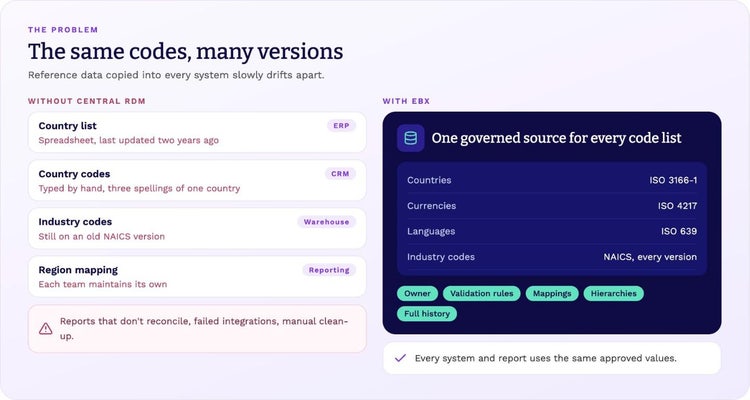
Reference data defines the values other data is allowed to take: country and currency codes, industry classifications, units of measure, product categories, legal entity types. It changes rarely, but every system, report and integration depends on it. When each application keeps its own copy, the copies drift apart, and the result is reports that don't reconcile and integrations that break.
EBX® gives reference data one governed home, with owners, rules, mappings, versions and full history, and shares it with the systems that need it.
The problem: the same codes, many versions
In most organizations, reference data lives in spreadsheets, application tables and hand-maintained mappings: a country list in the ERP, country codes typed into the CRM, an old version of an industry classification in the data warehouse, a region mapping that each reporting team keeps for itself.
The hard part is rarely the codes themselves. It is the business rules on values and relationships, the links between domains and between past, current and future versions, the local adaptations, the question of who is accountable for each list, and getting the right version to every system that uses it. Without a dedicated approach, the result is reports that don't reconcile, failed interfaces and hours of manual clean-up.
Public, shared and private reference data
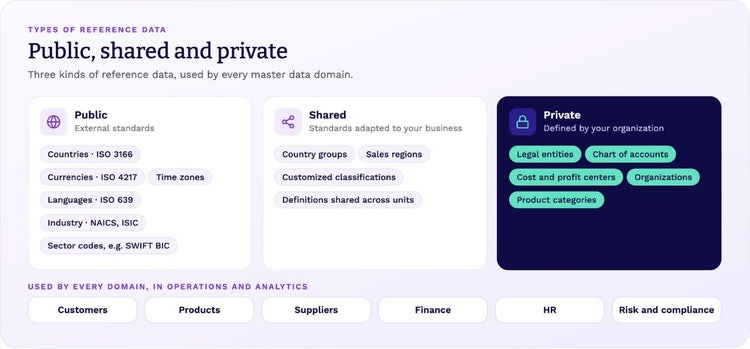
Reference data comes in three kinds. Public reference data follows external standards: countries, currencies, time zones, languages, industry classifications and sector codes such as SWIFT BIC. Shared reference data adapts those standards to your business, for example country groups or a customized classification. Private reference data is defined by your organization: legal entities, the chart of accounts, cost centers, organizations and product categories.
Most of it is used across domains. The same country, currency or legal entity code appears in customer, product, supplier, finance and HR data, and in both operational systems and analytics. That is why it pays to manage it once, in one place.
One governed home for every code list
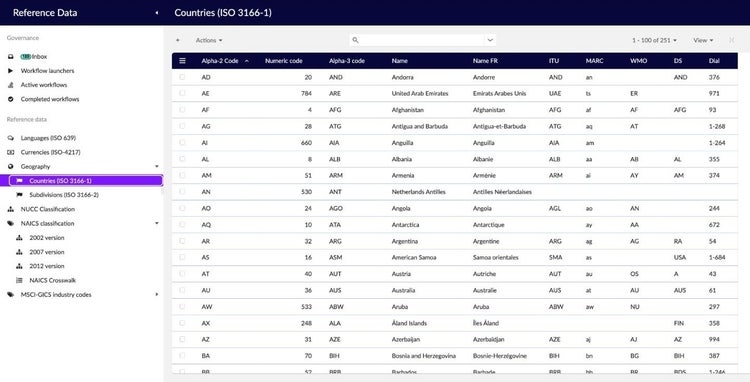
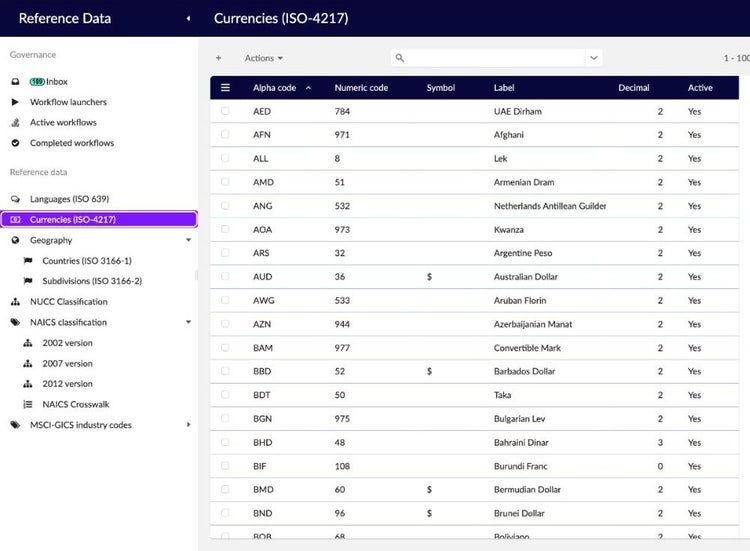
In EBX, reference data is organized into governed code lists that business users can find in one place: languages, currencies, countries and subdivisions, industry classifications and your own internal codes.
Each list is defined by a data model, so values are validated as they are entered, and permissions control who can see and change what.
Mappings and context on every value
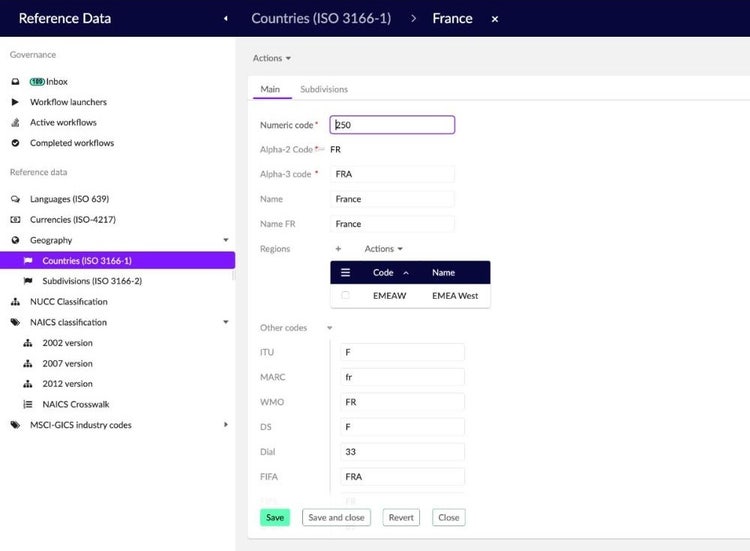
A code is rarely used on its own. Each record in EBX can carry its labels in several languages, its equivalents in other coding schemes and its links to related data.
In this example, the record for France holds its ISO numeric and alphabetic codes, its French name, its sales region and its codes in other standards used by partner systems.
Public and private reference data connect, too: a currency to the countries that use it, a country to its country groups, an airport to its country, an airline to the airports it serves. EBX manages these relationships with the same rules and governance as the codes themselves.
One standard, several views
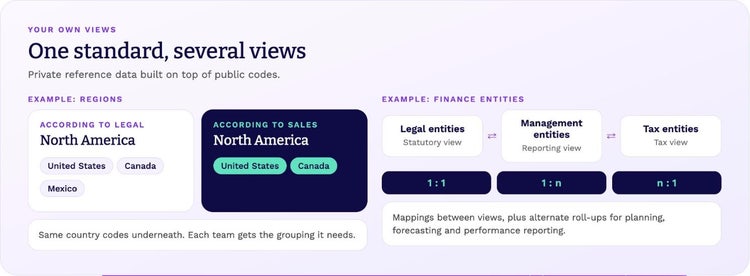
Organizations rarely use public standards exactly as published. To the legal team, "North America" might mean the United States, Canada and Mexico; to sales, only the United States and Canada. Country groups, sales regions and reporting roll-ups are private reference data built on top of public codes.
Finance adds another layer. The same business can be a legal entity, a management reporting entity and a tax entity, mapped one-to-one, one-to-many or many-to-one, with alternate hierarchies for planning, forecasting and performance reporting. In EBX these views, mappings and hierarchies are modeled alongside the public codes they depend on, so each team gets the view it needs while the underlying codes stay shared.
Hierarchies and versions
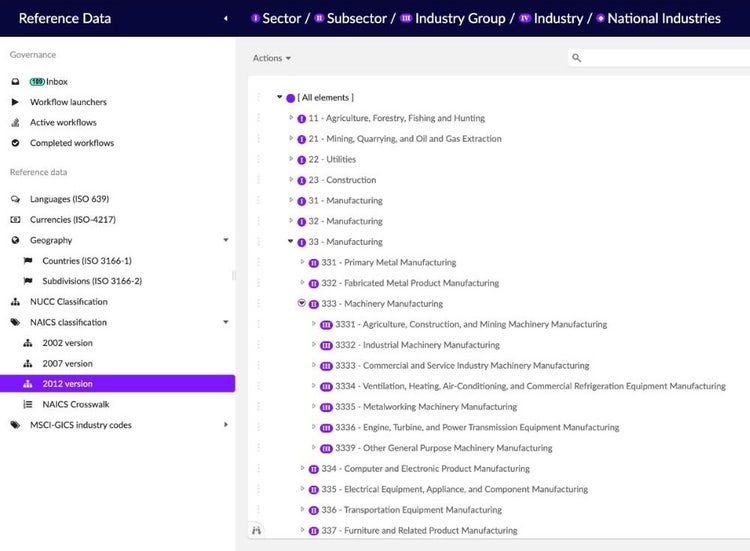
Many classifications are hierarchies, such as sectors, subsectors, industry groups and industries. EBX manages them as hierarchies, so users can browse, search and maintain them level by level.
Standards change, too. EBX can keep several versions of a classification side by side, such as the 2002, 2007 and 2012 editions of NAICS, so each system can move to a new version on its own schedule.
Crosswalks between versions and standards
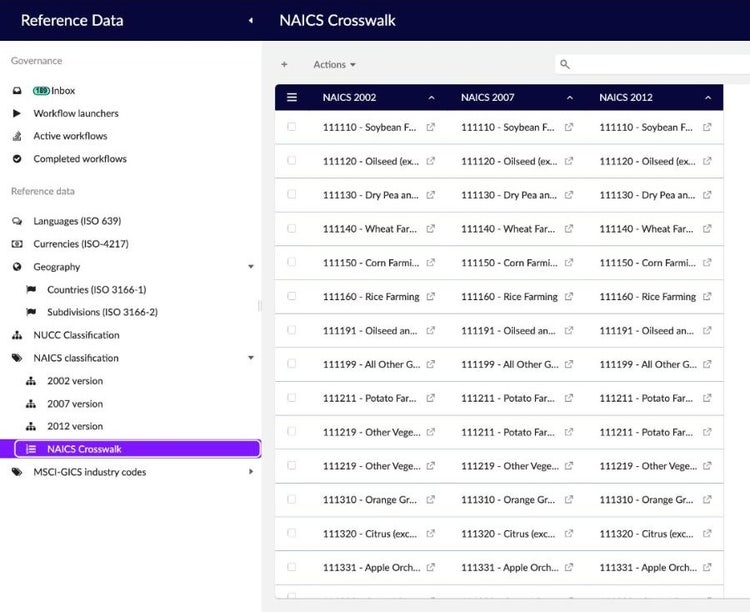
When a standard is revised, or two systems use different schemes, you need a reliable way to translate between them. In EBX, mappings are managed as governed reference data too.
The crosswalk shown here links each NAICS code across three editions, so a code from an older system can be translated to the current version. The mapping itself has an owner and a history.
Governance built in
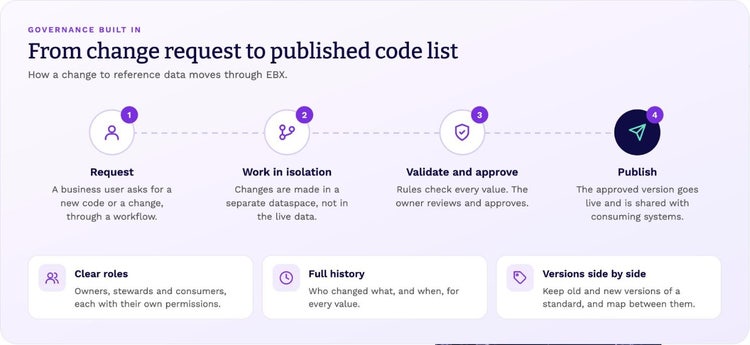
Changes to reference data follow a controlled path. A business user requests a new code or a change through a workflow. The change is prepared in a separate dataspace, away from the live data. Validation rules check every value, and the owner reviews and approves it before the new version is published.
Roles and permissions define who can request, edit, approve and consume each list, and EBX records who changed what, and when.
Shared with every system that needs it
Reference data is only useful when everyone uses the same version. EBX delivers approved code lists to applications, data platforms and reports through APIs, data services and file exports, so consuming systems pick up changes without re-keying them.
Because master data, reference data and metadata share one model-driven platform, the codes used to classify customers, products and suppliers are the same codes reported on everywhere else.
Lessons from the field
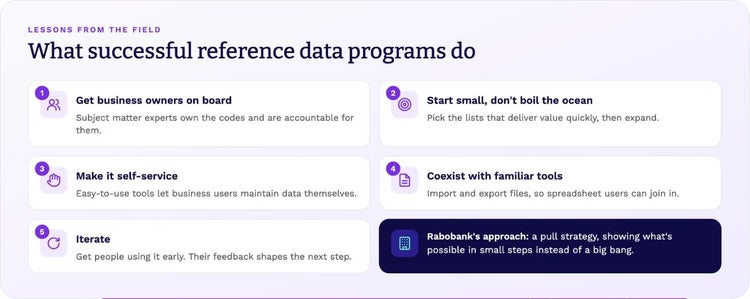
Reference data programs that succeed tend to follow the same pattern:
- Get business owners on board. Subject matter experts own the codes and are accountable for them.
- Start small. Begin with the lists that deliver value quickly, then expand.
- Make it self-service. Easy-to-use tools let business users maintain reference data themselves.
- Coexist with familiar tools. File import and export let spreadsheet users take part while the governed version stays in EBX.
- Iterate. Get people using it early, and let their feedback shape the next step.
Customer story: Rabobank
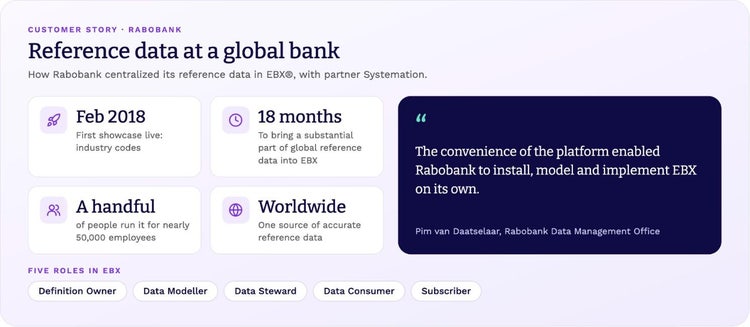
Rabobank set up a Reference Data Management Office and chose EBX after a proof of concept by partner Systemation. Its first showcase, industry codes, went live in February 2018. Within 18 months, a substantial part of the bank's global reference data was managed in EBX, by a small in-house team.
“Reference Data Management may seem only ‘nice to have’ in comparison to other data management aspects, but because it also influences the quality of data and reporting, it had to be addressed as well.”
Pim van Daatselaar, Data Management Specialist, Rabobank
Reference data management: common questions
What is reference data?
Reference data is the set of permissible values that other data can take, such as country, currency and industry codes. It changes rarely and is shared by many systems, so inconsistencies spread quickly. Learn more: What is reference data?
What is the difference between public and private reference data?
Public reference data follows external standards, such as ISO country and currency codes or industry classifications. Private reference data is defined by your organization, such as legal entities, the chart of accounts or cost centers. Most organizations also adapt public standards, for example with their own country groups or sales regions.
How is reference data different from master data?
Master data describes the core things a business works with, such as customers, products and suppliers. Reference data classifies them, for example with country, industry or product category codes. Learn more: What is master data?
Can EBX manage reference data and master data together?
Yes. EBX is a model-driven, multi-domain platform for master data, reference data and metadata, so classifications and the records that use them are governed in one place. Learn more: What is master data management?
Can we manage public standards and our own internal codes?
Yes. Public standards such as ISO country and currency codes, and internal codes such as product codes or reporting entities, can be managed side by side, each with its own owners, rules and permissions.
How do we handle a new version of a standard?
Keep the old and new versions side by side and maintain a governed crosswalk between them, so each consuming system can move to the new version on its own schedule. Definitions, owners and lineage for each list belong to metadata. Learn more: What is metadata management?
Bring order to your reference data
Talk to our team about your code lists, classifications and hierarchies, or explore how EBX® models, governs and shares master data, reference data and metadata in one platform.
