
MDM in the AI era
Why trusted master data matters more than ever
By Kinshuk Dutta · October 21, 2026
AI is only as reliable as the data it runs on
Every organization is asking the same question: how do we put AI to work safely and at scale? The conversation usually starts with models, agents and prompts. It should start with data. AI is only as reliable as the information it runs on, and the information it relies on most is the shared data that describes the business: customers, products, suppliers, locations, assets and the codes that classify them.
That data has a name. It is master data, and managing it well has never mattered more.
Why AI raises the stakes
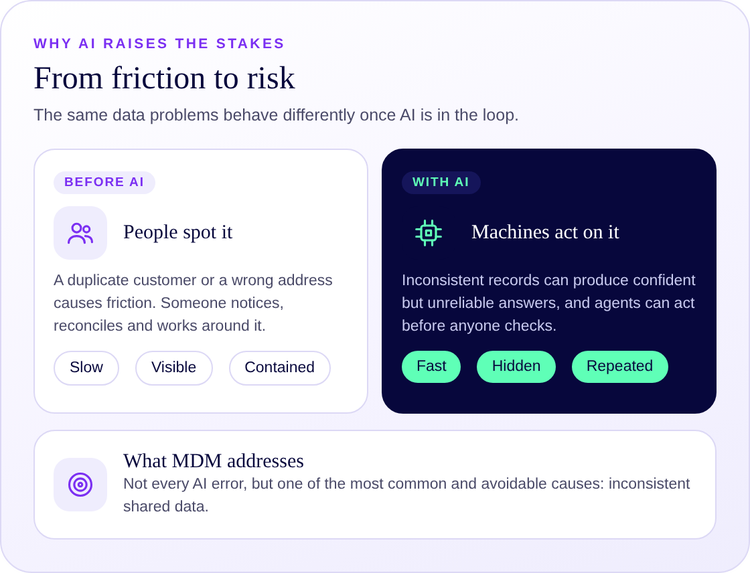
For years, poor master data showed up as friction: a duplicate customer here, a wrong address there, a report that needed reconciling before the board meeting. People noticed and worked around it.
AI makes those gaps harder to spot. A model or an agent can't always tell which of three customer records is current, or that two product codes describe the same item. Given inconsistent data, it can produce answers that sound confident but are unreliable, and an agent can act on them before anyone checks.
Better data won't remove every AI error. Models can still misread a question or reason badly. But inconsistent shared data is one of the most common and most avoidable sources of unreliable answers and actions, and that is the part of the risk master data management addresses.
An example: one customer, three versions
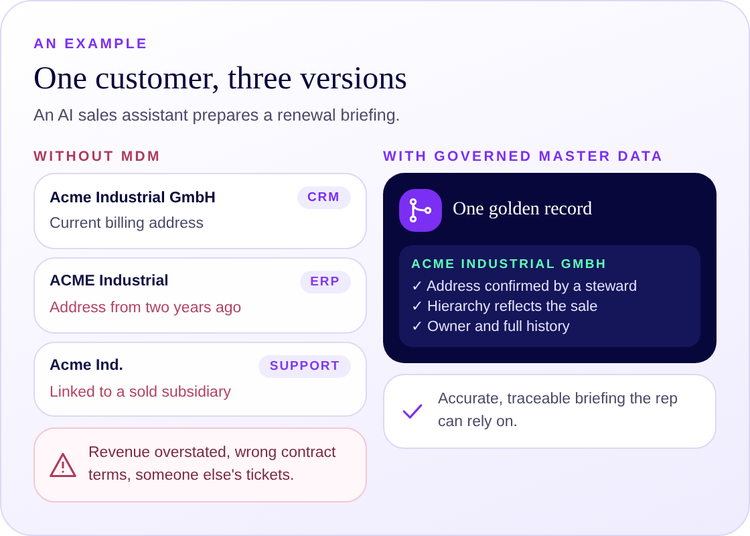
Picture an AI sales assistant preparing a briefing for a renewal call with a manufacturing customer. It searches the CRM, the ERP and the support system and finds three records: "Acme Industrial GmbH" with the current billing address, "ACME Industrial" with an address the customer left two years ago, and "Acme Ind." still linked to a subsidiary that was sold last year.
Without a single trusted record, the assistant has to guess. It might add up revenue across all three and overstate the account, quote terms from the wrong contract, or list open support tickets that belong to the former subsidiary. The sales rep walks into the call with a briefing that looks polished but can't be relied on.
Now picture the same assistant drawing on governed master data. The three records have already been matched and merged into one golden record, the hierarchy reflects the sale of the subsidiary, and the address was confirmed by a data steward. The briefing is accurate and traceable: if the rep asks where a figure came from, the answer leads back to an owned, audited record.
What AI-ready master data looks like
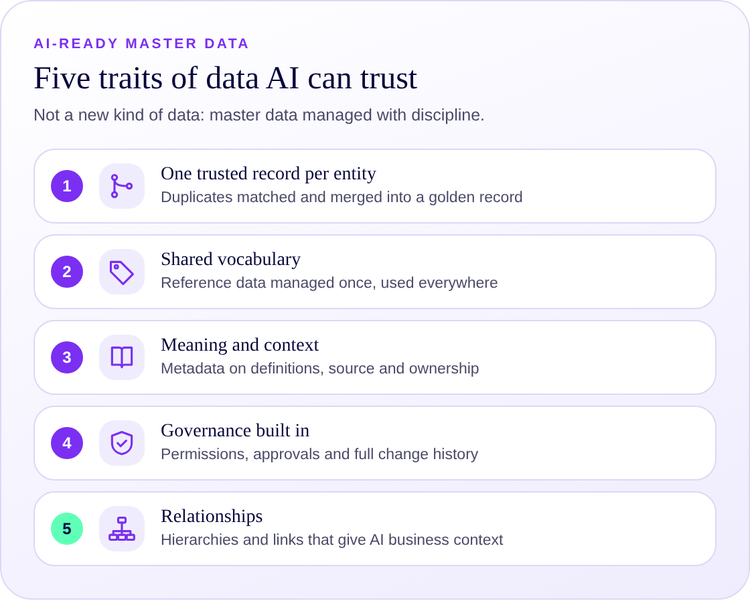
AI-ready master data is not a new kind of data. It is master data managed with discipline, so that it can be trusted by people and machines alike:
- One trusted record per entity: duplicates matched and merged into a golden record that every system and model can rely on.
- Shared vocabulary: reference data, such as country codes, product categories and cost centers, managed once and used everywhere, so AI compares like with like.
- Meaning and context: metadata that explains what each field means, where it came from and who owns it.
- Governance built in: permissions, approvals and a full history of changes, so you know who changed what, when and why.
- Relationships: hierarchies and links between customers, products, suppliers and locations, which give AI the context it needs to reason about the business.
Where MDM fits in an AI architecture
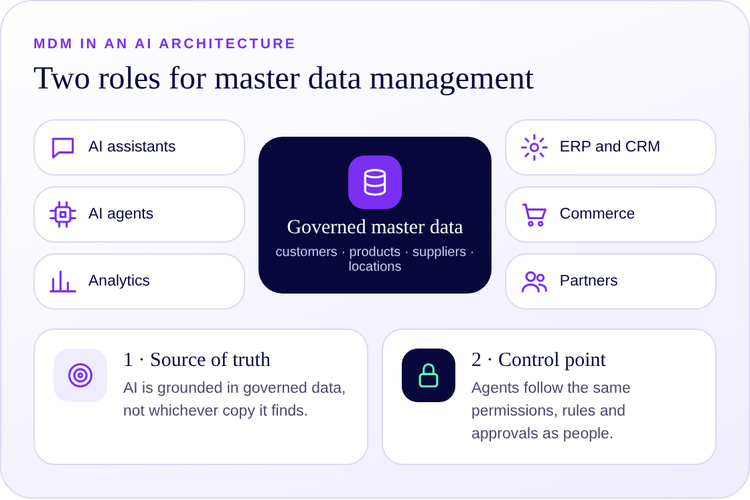
In an AI architecture, master data management plays two roles.
First, it is the source of truth AI is grounded in. When an assistant answers a question about a customer, or an agent prepares a quote, it should draw on governed master data rather than whichever copy it happens to find.
Second, it is the control point. Agents that read or propose changes to business data need the same permissions, validation rules and approval workflows as people. MDM is where those rules already live.
AI inside MDM: AI proposes, people decide
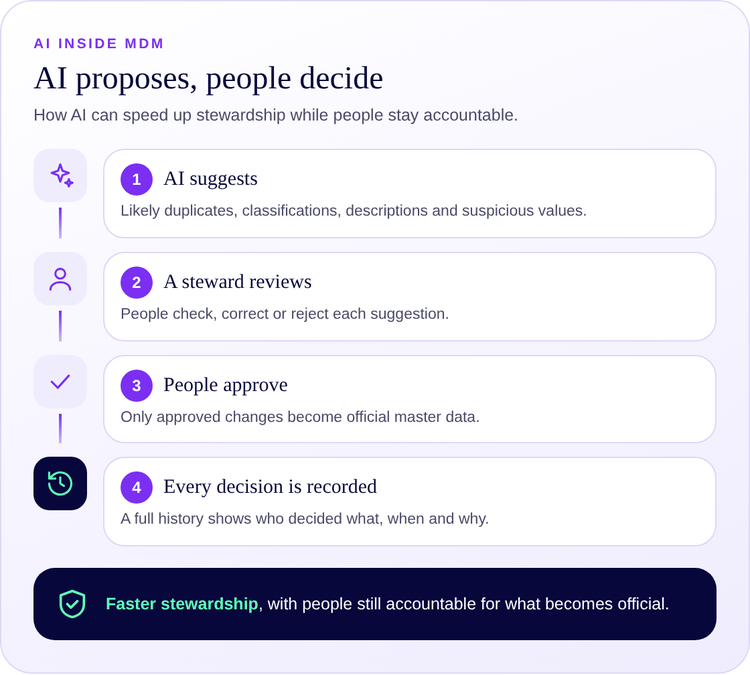
AI is also starting to change how master data itself is managed. Across the industry, teams are looking at AI to suggest likely duplicates, propose classifications for new records, draft data descriptions and flag values that look wrong, work that has always been slow and manual.
Whatever the tooling, the principle that matters is simple: AI proposes, people decide. Data stewards stay accountable for what becomes official, every decision is recorded, and the organization keeps control of its most important data.
Where EBX fits: context by design
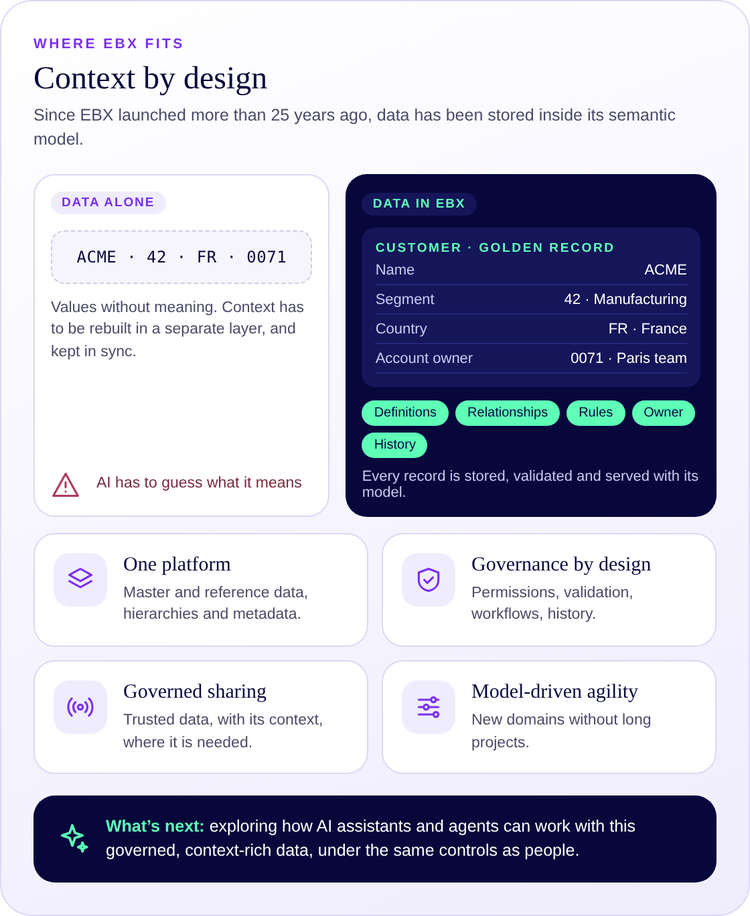
More than 25 years ago, when Orchestra Networks launched EBX® in 2000, its creators made an architectural choice that matters even more in the AI era. Instead of storing master data as rows and columns that get their meaning somewhere else, EBX keeps it inside a semantic model. Every EBX data model is a document that conforms to the W3C XML Schema standard, and every record is held, validated and served in the context of that model: what each field means, how it relates to other entities, which rules apply and who owns it.
So when an application, a report or an AI system retrieves data from EBX, the context comes with it. Many organizations have to build and maintain a separate semantic layer to give AI that context. In EBX, it is how data has always been stored.
On that foundation:
- One platform for shared data: master data, reference data, hierarchies and metadata managed together, with the relationships between them.
- Governance by design: permissions, validation rules, workflows and full history apply to every record.
- Governed data sharing: trusted data, with its context, delivered to the applications that need it.
- Model-driven agility: what you model is what you get, so new domains and attributes can be added without long development projects.
We're exploring how AI assistants and agents can work directly with this governed, context-rich master data, under the same controls that apply to people. We'll share more as that work matures.
Five steps to get started
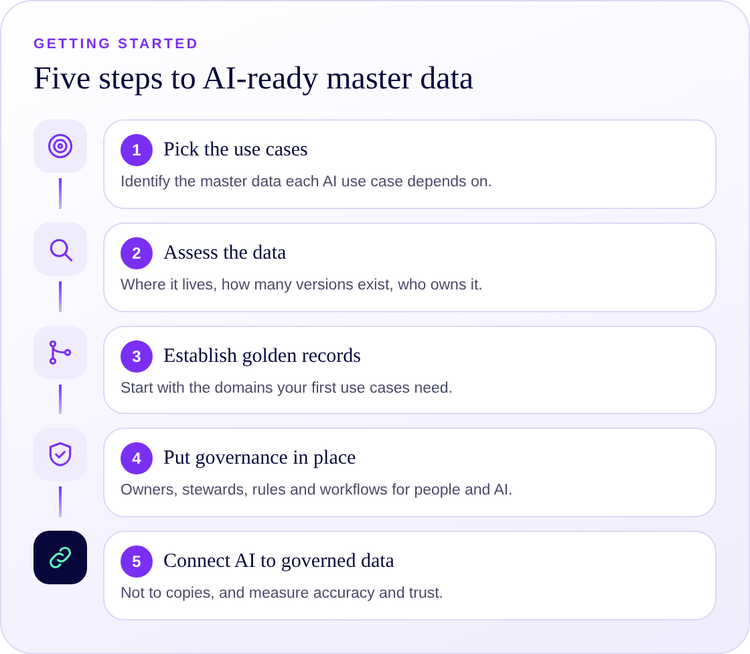
- Pick the AI use cases that matter and identify the master data each one depends on.
- Assess that data: where it lives, how many versions exist and who owns it.
- Establish golden records for the domains those use cases need first, rather than trying to fix everything at once.
- Put governance in place: owners, stewards, rules and approval workflows that apply to people and AI alike.
- Connect AI to governed data, not to copies, and measure the improvement in accuracy and trust.
AI will keep changing quickly. The organizations that benefit most will be the ones whose AI runs on data they can trust. That starts with master data.
Talk to an EBX expert about making your master data AI-ready.
Put trusted data at the core of your business
Talk to our team about your master data goals, or explore how EBX® models, governs and shares master, reference and metadata in one platform.
