
Every product, right everywhere
Product and material information is created by many teams: product management, engineering, procurement, regulatory, pricing. It then flows into ERP, plants, sales channels, catalogs and reports. When each system keeps its own copy, launches slow down, channels show different information, and compliance data falls out of step with the product it describes.
EBX® manages product data as governed master data: one record per product with its classification, composition, plant and sales views, prices and lifecycle, enriched by every team under the same rules and shared with every system that needs it.
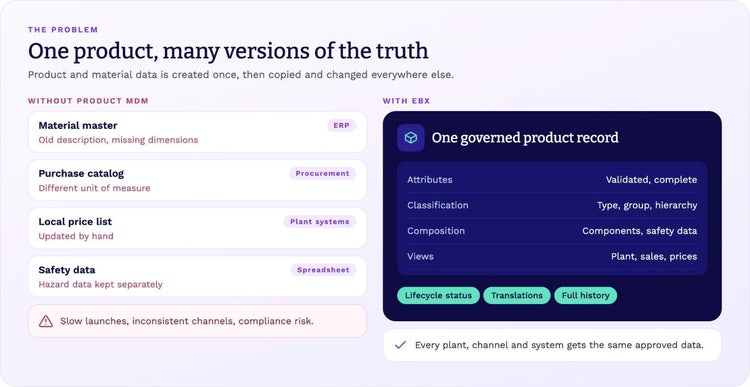
The problem: one product, many versions of the truth
The material master in the ERP has an old description and no dimensions. The purchase catalog uses a different unit of measure. Plant price lists are updated by hand, and safety data lives in a separate spreadsheet.
Each gap is small, but together they slow down launches, create errors in orders and invoices, and add real compliance risk when a product changes and not every system follows.
A governed catalog of every product
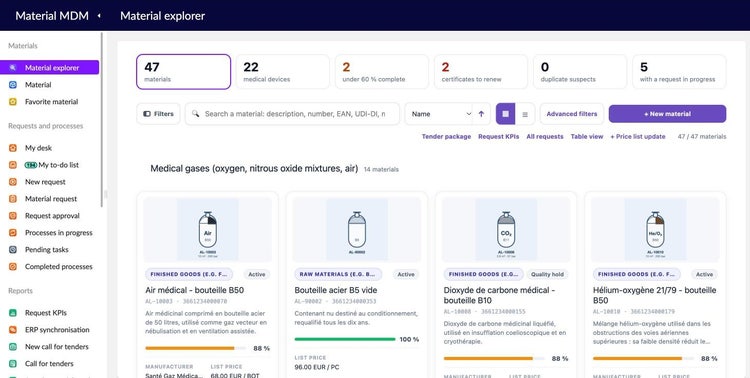
EBX gives business users one place to find and manage products and materials: a searchable catalog with images, types, statuses and completeness, filtered by type, status or manufacturer.
Indicators at the top show what needs attention, such as records under 60% complete, certificates to renew, possible duplicates and requests in progress.
Hierarchies, composition and linked data
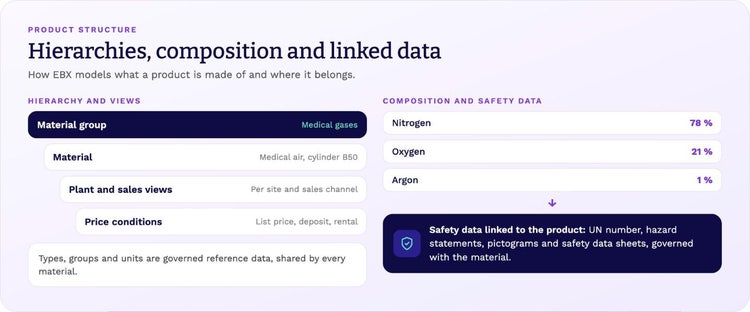
Products belong to groups and hierarchies, are made of components, and need views for each plant, sales channel and valuation area. EBX models each level and the relationships between them, so classifications stay consistent and every product sits in the right place.
Safety and regulatory data, such as UN numbers, hazard statements and safety data sheets, is governed with the product rather than kept on the side.
Composition you can trust
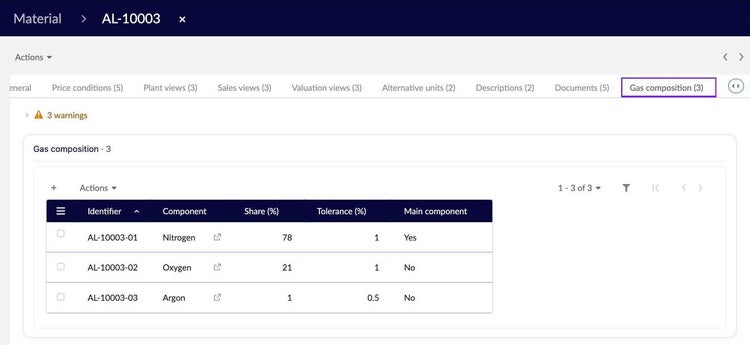
A product's composition is managed as related master data, with each component, its share, its tolerance and whether it is the main component.
In this example, a medical air cylinder is made of nitrogen, oxygen and argon. Because each component is itself governed, the same definitions are reused across every product that contains it.
A governed product lifecycle
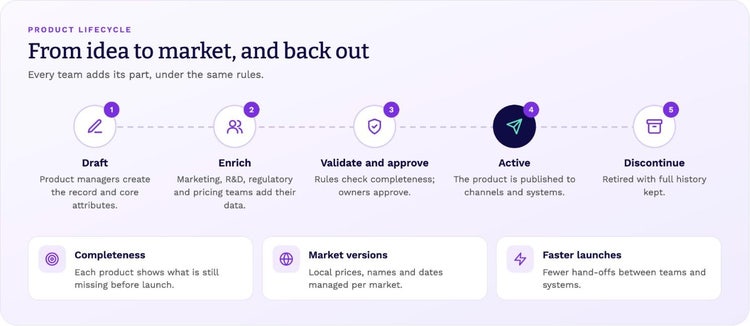
Products move from creation to active to discontinued. In EBX, each status change follows rules and, where needed, a workflow: product managers create the record, other teams enrich it, validation checks completeness, and owners approve it before it reaches plants and channels.
Completeness indicators show what is still missing before launch, and discontinued products keep their full history.
Quality checks and translations on every record
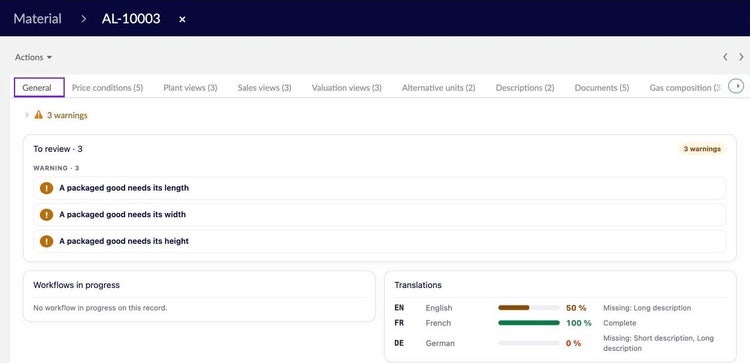
Validation rules run as data is entered. A packaged good without dimensions is flagged for review, and stewards see exactly what to fix.
Translation completeness is tracked per language, so a product is not released to a market until its descriptions are ready.
Prices and commercial conditions
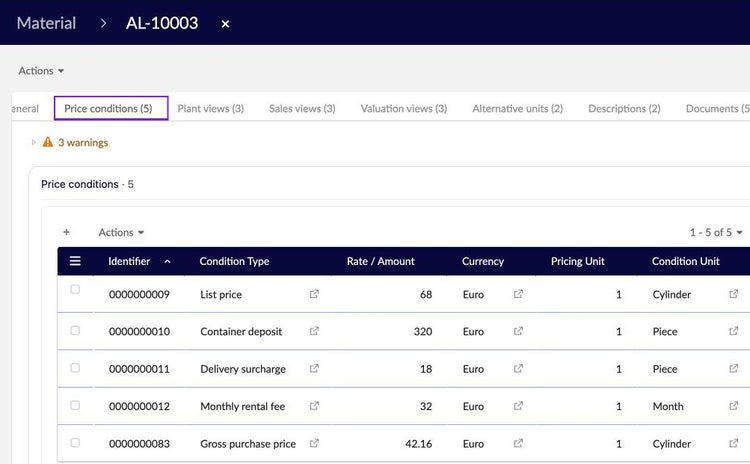
Commercial data, such as list prices, container deposits, surcharges and rental fees, is managed as conditions linked to the product, each with its amount, currency, pricing unit and validity.
Sales and finance teams work from the same governed conditions that are shared with ERP and order systems.
Customer story: Panera Bread
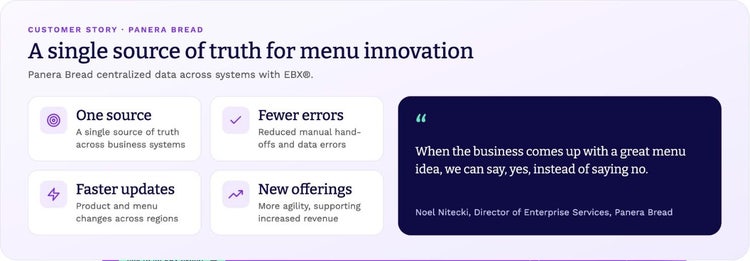
Panera Bread used EBX to centralize data across its systems and create a single source of truth. The result: fewer manual hand-offs and data errors, faster product and menu updates across regions, and more agility to support new offerings and increased revenue.
“EBX software is helping Panera Bread increase revenue by allowing flexibility of our menu, so when the business comes up with a great menu idea, we can say, yes, instead of saying no.”
Noel Nitecki, Director of Enterprise Services, Panera Bread
Product data management: common questions
What is product data management?
Product data management is the discipline of creating, enriching, governing and sharing product information, such as attributes, classifications, composition, prices and lifecycle status, from one trusted source. Learn more: What is master data?
How does EBX handle product hierarchies and views?
Product groups, hierarchies, materials and their plant, sales and valuation views are modeled as related tables, so each level can be governed and every product inherits the right classification.
Can EBX link safety and regulatory data to products?
Yes. Composition, hazard statements, UN numbers, certificates and safety data sheets can be managed with the product record, with their own validation rules and renewal dates.
Can we manage product descriptions in several languages?
Yes. Descriptions are managed per language, and translation completeness is tracked on each record, so you can see which markets are ready. Learn more: What is reference data?
How does product data reach our ERP and other systems?
Approved product data is shared with ERP, procurement, sales and analytics systems through APIs, data services and file exports, so every system uses the same version. Learn more: What is master data management?
Launch products faster, with data you can trust
Talk to our team about product catalogs, composition, safety data, prices and lifecycle, or explore how EBX® models, governs and shares master data, reference data and metadata in one platform.
