
Prove EBX on your own data
Your domain. Your records. Your success criteria.
A short, fixed-scope engagement that shows what EBX® does with your real data, including the records you know are bad.

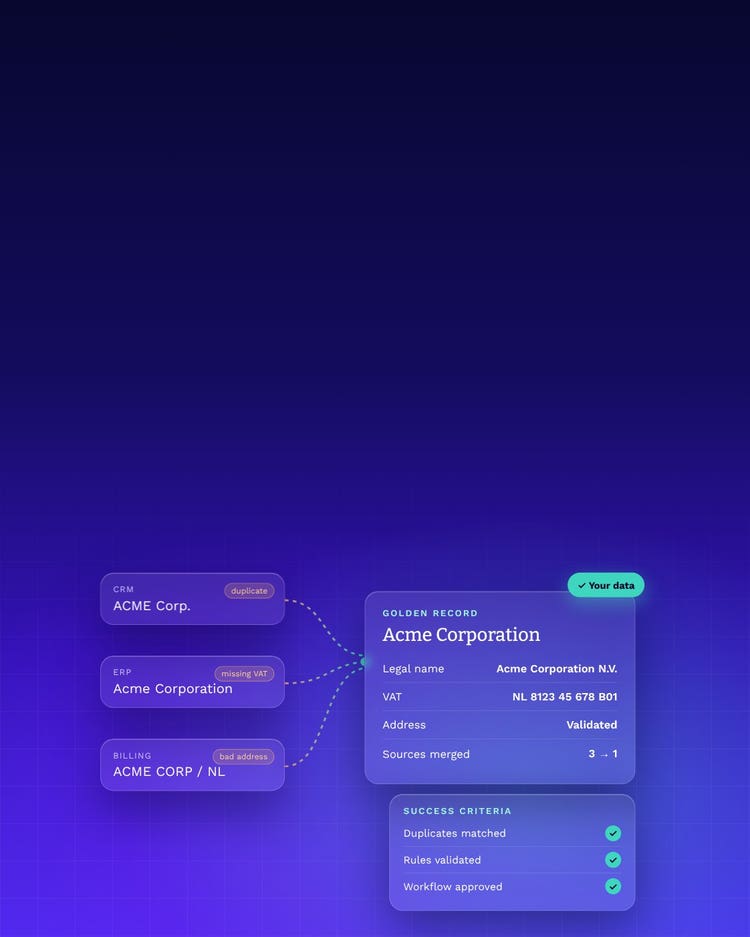
A working result, not a slide deck
At the end you have evidence your team can judge for itself.

Your domain, modelled
- Tables, relationships and hierarchies for your domain
- Your business rules as live validation
- A working user interface generated from the model

Your data, validated and matched
- Data quality issues found on load
- Duplicates matched into golden records
- Survivorship and steward decisions you can inspect

A governed workflow
- Search before create, so duplicates never start
- Request, review and approve, by role
- Full history and audit on every record

Duplicates stopped at the source
- Quick and advanced search before any create
- Match evidence shown side by side
- Reuse the record, or keep two entities apart

Data in and out, proven
- Every table available as a REST web service
- Spreadsheet import with a simulation first
- Changes staged in a dataspace before they merge

A readout against your criteria
- What worked, measured against each criterion
- Open questions and how to resolve them
- Inputs for your business case and next phase
AI agents do the build, so you see results sooner
EBX® 6.3 adds native Model Context Protocol (MCP) servers: six servers and 123 tools that let AI agents work inside EBX. In the video, one business request is enough for an agent to build a complete, governed item master: the data model, data quality rules, a form, an approval workflow and duplicate matching. In a proof of value we work the same way, and an EBX specialist reviews every change before it runs.

Faster to first result
The agent drafts your data model, validation rules, workflow and matching policy (with the matching add-on), instead of a consultant configuring each by hand.

Lower cost to prove
Most of the cost of a proof of value is specialist build time. Agents take on the repetitive configuration, so experts spend their hours on your rules.

Nothing to rebuild
What the agent creates is standard EBX configuration, so it carries straight into your first production phase.

Governed by design
Agents act within EBX permissions, with the same validation, history and audit as people.
Four steps, agreed with you on day one
A fixed scope and clear criteria, so everyone knows what success looks like before any data moves.
Step 1
Agree scope and success criteria
One domain, a handful of source systems and three to five measurable criteria.
Step 2
Load a real sample
You provide an extract of your data, including known problem records.

Step 3
Model, validate and match
We build the model, rules and workflow in EBX together with your team.
Step 4
Review the results
We go through the outcomes against your criteria and agree next steps.
Judge EBX on the records that cause you trouble
A proof of value runs on your data, not vendor samples. You see your duplicates matched into golden records, your validation rules catching errors, and every merge decision kept in the record history.
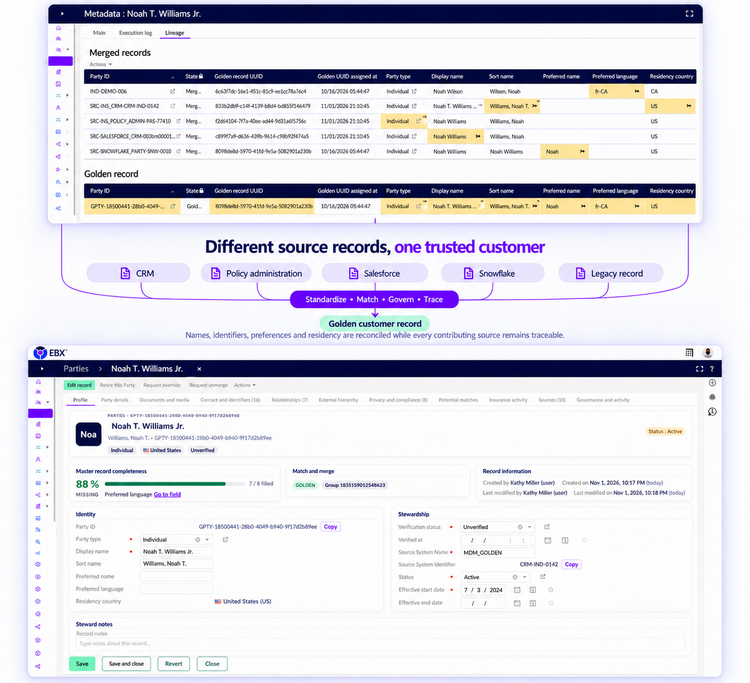
Free, for two months, in your environment
Real evidence before you buy: EBX on your own data, measured against criteria you set.
2 months
Duration
On an EBX trial licence

Free
Cost
Measured against success criteria agreed up front

Your environment
Where it runs
ON EBX provides the software and the licence

2 + 1
Who takes part
A data owner and a technical lead from you, an EBX specialist from us
Is a proof of value right for you?
- You have a defined domain and a business owner for that data.
- You have a decision to make in the next few months.
Earlier in your evaluation? Start with the product demos and the architecture brief.
Proof of value: common questions
Ready to prove EBX on your own data?
Tell us which domain you want to prove and what success looks like.
