How to Sell the Business on Data Catalogs
From Data, Data Everywhere...
Data equals opportunity. The more data the better.
But because your data is so distributed across a diverse landscape of applications, databases, marts, warehouses, and lakes, both on-premises and in the cloud, simply accessing all your data is a huge challenge.
How big? Here are some numbers.
- According to IDC’s 2019 Data Integration and Integrity End User Survey, “25% of analyst time is spent searching for data.”1
- A 2020 Wisdom Of Clouds Data Catalog Study by Dresner Advisory Services noted that “Fifty-one percent of respondents indicate analytic consumers and use cases have difficulty (impossible, difficult, or somewhat difficult) locating/accessing relevant analytic content.”2
- Dresner also found that “the harder it is for BI users / use case to find and access content, the higher the likelihood that BI initiatives will not be successful.”2
... To Data, Data Where We Can Find It
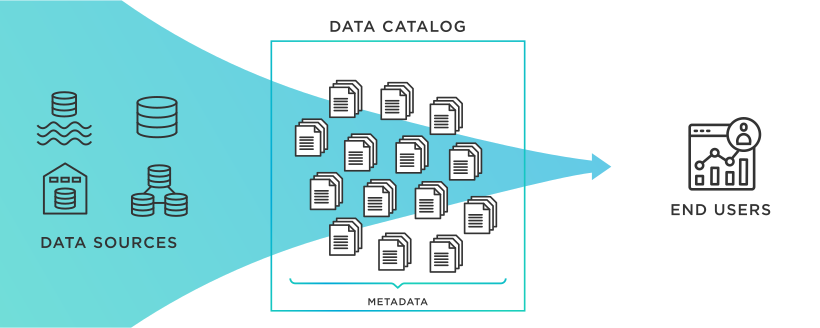
Data catalogs have been around for years, primarily used by data stewards to catalog technical metadata, typically related to data sources.
Recent developments include:
-
More and more diverse data asset types beyond technical metadata such as schemas and relationships to include:
- Data operations information such as lineage, provenance, and performance
- Technical business information such as ontologies and business rules
- Informal social information such as user-generated comments
- Analytic model metadata including visualizations, dashboards, and reports
- Actual data sets delivered with common access, security, and control
-
More and more diverse user types beyond data stewards to include business analysts, data scientists, data curators, and data engineers.
-
More functionality expanding beyond data inventory and search tools, to embed AI and machine learning that improves data discovery and understanding as well as collaboration tools that support crowdsourcing of insight across this expanded user community.
Standalone Versus Embedded Data Catalogs
With more assets, more users, and more functionality, how do you know where a “data catalog” ends and broader enterprise data management begins? Vendors answer this question differently, some with standalone data catalogs, others with catalogs embedded within more unified data management suites.
TIBCO offers the unified approach so you can implement one set of data definitions, one data catalog, one point of access, one security model, and one governance system— across all your data. TIBCO’s recently released TIBCO CloudTM Metadata, embeds a data catalog so you can holistically access and manage all your metadata including business metadata (glossaries, definitions, policies, rules), physical metadata (data dictionaries, data lineages), and the data assets (datasets, entitlements) in one place. Its self-service catalog simplifies searching, understanding, and requesting datasets you are entitled to. And with TIBCO Data Virtualization you can be sure your data is business-friendly and performant.
Business Benefits are Significant and Compelling
To get the business on board, there is no need to talk about the wealth of data catalog capabilities, nor clarify where data catalogs stop and data management begins. Instead invest your time in showing them how a data catalog can deliver these three high-impact business benefits:
- Fast and easy access to data is a data catalog’s most obvious benefit. With it you can use the time that might have been spent searching for the data to time spent gathering business insight and driving business value.
- Comprehensive insight into that data is another benefit enabling your business users to better understand your data and use it properly.
- Further, by enabling “wisdom of crowds” driven collaboration that spans business and IT teams, data catalogs let you further expand your organization’s data understanding and drive even greater value-add, avoiding the pitfalls that result from siloed organizational structures and employees with valuable, albeit specialized skills.
- With more time, insight, and an expanded team, faster time to business impact is the fourth, and perhaps most valuable benefit. This is especially true for data-driven organizations where data is key to your competitive success.
Building a CFO-ready Business Case
While the benefits are high, implementing a data catalog successfully requires software, hardware, staffing, and expertise. This multifaceted effort requires a sound financial case. In The Business Case for a Data Catalog, my friend Dave Wells, who runs the data management practice at the Eckerson Group, provides an excellent template you can use to build your CFO-ready business case.
The Bottom Line
With compelling benefits at hand, and powerful new capabilities available, now is the time to adopt data catalogs. For more on how to initiate governed, self-service analytics applications, check out TIBCO’s data catalog solution.
- End-User Survey Results: Deployment and Data Intelligence in 2019, Stewart Bond, IDC, Doc # US45652419, Nov 2019
- 2020 Wisdom Of Clouds Data Catalog Study by Dresner Advisory Services